Saturday, February 16, 2013

Electrons, Strings and Spooky Action

After I wrote the Atoms series in this blog, I felt for just a moment I knew the atom's tricks, but the truth, surprisingly, is that no one does. Atoms are weird, especially the electrons within them. I warn you this story doesn't end neatly.

Modeling the Electron

Looking at Bohr models, these fundamental building blocks of matter seem straight forward enough. Below right is a Bohr diagram of a phosphorus atom. Electrons are shown in grey and the nucleus is shown in green.


Each electron whirrs around the atomic nucleus, confined to a shell (each circle) that corresponds to its energy. Its electron configuration can be written as 1s22s22p63s23p3. You can learn how to write these configurations in Atoms Part 4A. Even the quantum mechanical model doesn't seem too far out if you think of electrons as clouds shaped by where one might be at any given time. Phosphorus has six electrons in its 2p orbital, for example. Below left is a diagram of how that orbital is organized into three suborbitals, each one filled with two electrons, one per lobe.


Despite all of this understanding, there is a heart of weirdness in every electron. If you are like me and you only feel comfortable when you can get a mental image of what you're thinking about, the electron is destined to continuously throw stones at its own reflection. The days of thinking of them as little billiard balls or tiny planets orbiting a tiny Sun are long over.


Measuring the Electron

Let's start by going over what we do know: As far as anyone knows, electrons aren't made of any smaller parts. They are simply full of "electron stuff." Each electron is a magnetic dipole (a tiny magnet) and an electric monopole (a tiny charge). It has an intrinsic quantum spin, which we'll explore in detail, and a rest mass. As an electron approaches the speed of light, its mass is better described as relativistic mass as Einstein's theory of special relativity comes into play. Its mass, from an observer's point of view, increases and ultimately approaches an infinite value as it approaches the speed of light.

The size or diameter of an electron is very difficult to say. The classical radius of an electron is about 2.8 x 10⁻¹⁵ m, based on its mass, its charge and the permittivity (resistance against an electric field) of empty space. It's an estimate of how big the electron would need to be if all of its electrostatic potential energy is converted to mass. This number is used in modern classical theories like Thomson scattering but it is no longer thought of as the actual size of an electron because quantum mechanics, needed to understand it, regards the electron as a cloud of probability with an indefinite outer edge. Mathematically, it treats the electron as a size-zero point. In quantum field theory, it is an excitation in a field so size doesn't have any relevance. In string theory, an electron would be a string with a length that is a compromise between its tension (wants to make it smaller) and Heisenberg's uncertainty principle (resists being a single point). You can't measure an electron by the size of hole you can shoot it through because it doesn't need a hole, as in the case of quantum tunnelling. Its size does not appear to be strictly the size of its wave function because these functions are probabilistic, meaning that they ultimately extend to infinity.

An electron, however, can have linear momentum and kinetic energy as it flies through space-time. Inside an atom, its energy is confined to specific energy shells.

Each of these electron qualities (except size) has a value you can measure very precisely. Some values, like velocity and charge, can be measured using classical mechanics. Values, like linear momentum and mass, must sometimes be relativistic - you need to use the theories of relativity in order to measure them when an electron is traveling close to light speed. Other electron qualities are described by quantum numbers. Its magnetic dipole is a quantum number. So is its intrinsic spin and the energy and shape of its orbital inside an atom. What makes these numbers "quantum" is that when you measure any of them you will get only discrete values. For example, in an atom, an electron's energy is confined to a limited set of values. It's not allowed to possess any energy in between those values. This concept is explored in detail in the article, Atoms Part 2. Below, electrons in an oxygen atom are allowed in two (ground state) energy shells (black) and at least two excited energy shells (grey) but not in between them.

Quantum mechanics gives scientists a great deal of information about electrons but it also means that electrons are slippery in their hands. You can't know everything about an electron at the same time. This is the essence of Heisenberg's uncertainty principle. You can't pin down both its momentum (or velocity) and its location, for example. Young's famous double slit experiment means that electrons also show both wave and particle behaviour at the same time. Whether an electron acts like a wave or a particle depends on how you decide to measure it. Maybe it's more accurate to say how you see the behaviour depends on how you measure it, to get way from the idea that the electron physically changes thanks to your eyeballs happening to be on it. The Copenhagen interpretation of quantum mechanics says that the wave function of an electron collapses when you observe it, and it implies that quantum mechanics does not describe the electron's reality - it deals only with probabilities - that what you measure will be this value or that. An electron really does have a particle/wave nature to it and it really can be completely described by a wave function. However, quantum mechanics, while offering a mathematical description, does not let us probe and examine an electron as if it were an ordinary (classical or Newtonian) object.

What Electrons Do

Despite the complex quantum nature of their electrons, atoms tend to follow rules, which make it possible to predict how they will act with one another (this is chemistry, explored in Atoms Part 4A, B, C D and E) and how they react to changes in energy by vibrating (incandesecence, described in Atoms Part 3) or emitting light (luminescence, described in Atoms Part 2), all of which intimately involves the atom's electrons. Scientists also have a good grasp on how atoms stack together in various materials - interactions between countless electrons in the outermost (valence) orbitals of the atoms in these materials determine how they stack themselves. Electrons can even smear quantum aspects of themselves by sharing interconnected valence orbitals (Atoms Part 4C). The metallic bond (Atoms Part 4D), for example, is dispersed evenly across the entire metal, allowing it to conduct a current. This electron arrangement is called delocalization. A three dimensional lattice of metal atoms is held together by many shared valence orbitals. The bonding electrons, those in the valence energy shell, do not belong to any particular atom or bond. Instead they exist in orbitals shared across several atoms and/or bonds (they do not exist outside the valence energy shell as many online teaching videos incorrectly show). These molecular (bonding) orbitals are hybrids of the individual atomic valence orbitals, and they are described by a different set of quantum numbers than atomic orbitals are.

The "smearability" of electron valence orbitals is thanks to the wave nature of the electrons themselves. I came face to face with this weird ability while researching the article "Quasiparticles." In that article I explored how the concept of the atom evolved from a billiard ball into the modern quantum mechanical model, how quantum field theory works and how phenomena like quasiparticles emerge from complex three-dimensional systems of atoms inside solid materials. The phonon, a quantum vibration, is an example of a quasiparticle that we'll encounter later on in this article.

Electrons can also pair up their spins in order to align their magnetic moments, showing off their inherent magnetism within magnetic objects. Magnetism can be quite complex. Each electron has an intrinsic spin and a charge. Magnetism arises from this moving charge, turning the electron into a tiny bar magnet. Electrons moving inside orbitals also contribute to the magnetism of materials. I explored these interesting phenomena in five Magnetism Explained articles.

Electrons are fascinating multifaceted entities. But there is one thing electrons do that seems to defy explanation altogether: spooky action at a distance. Albert Einstein famously came up with the phrase itself and quantum entanglement, as it is scientifically called, has bugged scientists ever since.

Spooky Action

In the early twentieth century, Einstein and his contemporaries were busy figuring out the quantum nature of the electron. They realized a consequence of their developing theory was that no two particles of matter, including electrons, could share all the same quantum numbers at the same time. This is the essence of the Pauli exclusion principle. It means that only two electrons can share a single energy orbital in an atom.

Quantum Spin

Two electrons are allowed, rather than just one, because electrons come in one of two possible quantum spins, usually called up and down for convenience. This spin quantum number is a measure of the electron's intrinsic angular momentum. Sometimes this number gets confused with the angular momentum number, which describes the orbital angular momentum, the shape in other words, of an electron orbital. That number is very important in chemistry because it influences bonds and bond angles between atoms. The electron's intrinsic angular momentum, on the other hand, is sometimes interpreted to mean that the electron is a tiny spinning sphere. This quality, however, is a purely quantum mechanical concept that doesn't have a counterpart in classical mechanics. In classical mechanics, any object can have angular momentum. It is a product of two measurements: rotational inertial and rotational velocity. It's what keeps the gyroscope spinning upright, below.

Kiko2000; Wikipedi
An electron is a little different from a gyroscope. The gyroscope experiences something called external torque - friction robs it of energy and it eventually falls over. In a system where there is no external torque - inside the vacuum of space - angular momentum is conserved. It doesn't get lost anywhere. That's what keeps planets, stars and galaxies spinning. All electrons come with, and can never lose, exactly the same angular momentum value. It is an intrinsic part of their "electron stuff," even though an electron, according to quantum mechanics, has no diameter about which to spin. If an electron had classical angular momentum, it would be altered when it collides with other particles.

Electrons confined to atoms have set values not only for angular momentum but also everything else, except energy. Here, they have a few choices, as I mentioned earlier, and these choices place an electron in one of a set of possible energy shells. A single energy shell can and usually does contain more than one orbital. Because of quantum mechanics, two electrons in an atom can only share the same orbital (same energy and same angular momentum number) if they do not share the same intrinsic spin direction - one can spin up and one can spin down. You can think of the spin in classical terms as one with a right-hand spin and the other with a left-hand spin.

This facet of electron behaviour is part of what gives various atoms their size. New orbitals must be layered on top to accommodate increasing numbers of electrons in larger atoms. Innermost electrons tend to get squished a bit closer to the (positively charged and repellent) nucleus as you go up in atomic number. If electrons could all share the same energy, they would all squeeze into the lowest energy orbital possible and everyday matter, as we know it (as well as chemistry, magnetism, electricity and even light), would be vastly different, if possible at all. As you will see later on, electrons will occasionally "break the rules" and do just that.

The weirdest thing about the quantum spin of an electron is that it exists as a superposition of the two (up/down) states. This phenomenon, first described by Paul Dirac in the1930's, arises from solutions to Schrodinger's equation, which is a core part of quantum mechanics. Most of the time, scientists don't need to think of the spin this way, but it's what makes spooky action spooky, as we'll see. This may seem to contradict the Pauli exclusion rationale I just talked about and you might be asking, how do you even know there are two spins then? You can very quickly get into some dicey territory as you consider the ramifications of the Pauli exclusion principle and superposition. What happens if one electron of an entangled pair is in a collision that changes its energy and momentum? Does the other electron's energy and momentum change? The answer as I understand it is no. For example, in an experiment done last year in Austria, researchers got a group of 14 calcium ions caught in an electromagnetic trap to become an entangled coherent unit. Once entanglement is achieved, outside noise destroys it at a rate proportional to the square of the number of entangled units. Using this logic, I suspect that the collision of one electron would be considered enough noise to instantly turn the pair into an incoherent state. Try this Discover blog article, where physicist Sean Carroll starts out questioning some of celebrity physicist's Brian Cox's "A Night With The Stars" lecture about quantum entanglement and ends up having "fun" attempting to reconcile the Pauli exclusion principle and quantum entanglement. Not only entertaining in its own right, it shows how an expert grapples with these concepts.

Spin can indeed be measured, but it is neither up nor down until you measure it. This is reminiscent of the electron cloud we encountered in Atoms Part 4A. The electron is neither here nor there and everywhere all the same time until you measure its location. When you measure the electron's spin, the quantum uncertainty, expressed as a wave function, collapses and at that point the spin of that electron has a 50/50 chance of being up or down. It will be one or the other. This concept, in and of its self, may be difficult to buy but is not too difficult to digest. The implications of it are.

Spooky Action Breaks The Speed Limit

If you take a pair of free electrons and make sure they are both in exactly the same quantum state, they are now entangled in the quantum sense. You can then separate them and measure the spin of one of the electrons. You will discover this one is spin up for example. If you observe the other electron you will find it's wave function has collapsed into down spin. Physicists have been able to take measurements over such precise intervals that the information "received by" the second electron must happen faster than the speed of light!

Einstein thought this scenario through several decades ago and the idea of faster-then-light information transfer went against everything he knew about special relativity - one of his great theoretical legacies. He called it spooky action at a distance. Scientists around this time had thought up ways to accurately measure the speed of light and they always found it to be the same value, no matter whether the light source was moving toward or away from the measurer or the measurer was stationery. If the speed of light never changes, it means time and space have to give instead, based on Einstein's theory called special relativity. Realizing that space and time are flexible, Einstein went on to build a new theory of gravity based on space-time curvature. Relativity also means that the momentum (you can also call this relativistic mass of any particle with mass will approach infinity as it is accelerated to light speed. A particle without mass, such as a photon - travelling at light speed - also has momentum, but it is not infinite and it is calculated slightly differently. Relativity also means that an object travelling faster than light speed would, according to an inertial frame of reference, be travelling backward through time. This would violate causality, which in scientific terms can be described as a violation of the second law of thermodynamics. For example, a smashed glass of wine will never reassemble itself - every action has a one-way time arrow, an idea I explored in Time.

The speed of light is the speed limit of the universe. The violation of the second law of thermodynamics extends the speed limit from objects with mass to the speed limit for information travel as well, and no such violation has ever been measured. Almost every physicist considers light speed to be the speed limit of the universe, for objects and for information. Fields of force such as magnetic, electrical and gravitational fields, all propagate at the speed of light.

So how do electrons get away with it? One answer is that they do not break the second law of thermodynamics because no information is actually transmitted - you can't know whether the initial spin is up or down before you measure it and collapse the second electron, so you can't send information this way. Many theorists find this argument too easy. Even though you can't dictate the information, something somehow is telling the second electron what spin to collapse into. Not only do electrons get entangled, but photons, the calcium ions I mentioned, and even macroscopic objects like the diamonds Dr. Cox referred to in his lecture can form quantum-entangled pairs as well. It seems that these particles and objects, at least from a quantum mechanical point of view, are not limited to the dimensions of space-time we experience.

If we accept that all the physical laws must remain intact, entanglement means that two electrons, separated by distance, somehow can act like one single entity. If you do a one eighty, the question becomes how does the universe make one electron look like two? Like the black hole problem, this question seems to be about the nature of space-time.

How To Explain Spooky Action > Remove A Spatial Dimension

There have been a few theoretical attempts to explain the universe with quantum entanglement and all the known theoretical laws intact. One that stands out is the Holographic principle, a possibility I explored in the article, Holographic Universe. In a nutshell, this theory suggests that everything in the universe is a four-dimensional hologram of an underlying two-dimensional reality. The edge of the universe is like the inside of a balloon and according to this principle the entire universe is, in reality, confined there. The four dimensions we experience are a hologram projected from a two-dimensional information structure painted on the inside of the balloon. The idea was born as a way to explain how a black hole can seemingly erase all the quantum information encoded in the material that it gobbles up, and still not violate the second law of thermodynamics. Gerard 't Hooft and Leonard Susskind used the mathematics of string theory to take a four-dimensional black hole (includes time) and turn it into a two-dimensional information structure called a worldsheet. 't Hooft reasoned that incoming and outgoing particles (some are emitted from the black hole through Hawking radiation) deform the sheet, leaving imprints of their quantum information. Susskind was able to describe these imprints mathematically as holograms.

Theorists have attempted to connect this principle to the quantum entanglement problem and some suggest that the bridge between the two might be the Bohm interpretation, also called the Broglie-Bohm theory and the pilot-wave theory, of quantum mechanics. As I understand this theory, which came together in the 1960's, the position and velocity of any particle is defined by its wave function through something called a guiding equation, which allows the wave function to evolve over time. The guiding equation takes into account all the wave functions of all other particles in the universe by encapsulating them into one giant wave function. It attempts to describe an electron's environment as one that is dependent on a statistical average of what all other particles in the universe are doing, and in this way the electron is able to exchange information instantaneously with all other particles, including the entangled partner. In fact, in the eyes of the Bohm interpretation, the electron's spin is not an intrinsic property of the electron at all - it is its wave function in relation to the wave function of the device used to measure it.

If you connect this interpretation to the Holographic principle, you can imagine the wave functions of all particles in the universe mathematically encoded (and interconnected) on the two-dimensional information sheet.

In quantum field theory, all particles of force and matter can be described by a series of mathematical values called operators, which are continuously varying wave functions, where some or maybe all wave functions are entangled with others.

One wave function in two dimensions can look like two separate particles in four dimensions. Going backwards, you can take two separate electrons in three spatial dimensions and condense the dimensions into two. The two electrons are a hologram of one wave function located on a two dimensional information sheet, shown below.


Scientists see one electron that is able to correlate with another distant electron in a way that classical mechanics can't account for. They call this phenomenon nonlocality. Locality in quantum physics is not a straight cut concept. Instead it is subtle and open to interpretation, when you consider the uncertainty underlying where a particle is and what it is doing as well as the effects of various fields on it. In addition, the particle itself may create fields - each electron creates an electric and magnetic field that weakens with distance but, according to quantum mechanics, has infinite range. This is part of what I think Dr. Carroll was getting at in his blog article. In contrast, all the physical laws in classical mechanics and relativity depend on locality: a particle is a point-like object and it is influenced directly only by its immediate surroundings, whether they are force fields or other particles.

user:Belsazar;Wikipedia
The holographic principle, largely built from string theory, allows entangled electrons to interact outside the bounds of four-dimensional space-time. If we could un-glue ourselves from space-time and see this underlying two-dimensional reality, we would see the electrons not as two distinct particles moving separately through space and time but as some kind of single entity. If we took a second look at Young's double slit experiment, we would not be so shocked to see electrons, shot one at a time, somehow build up a perfect wave interference pattern, as shown right.

The electrons in the experiment are, after all, according to this principle, interconnected within a two-dimensional structure and they are not confined to our space-time. Keep this general thought in mind as you read on. It is, by accident, the same conclusion another researcher, through a very different line of reasoning, recently comes to, except that instead of condensing the four dimensions we experience, he expands them.

Besides offering a coherent way to look at a black hole, the Holographic principle is attractive for two other reasons as well. The entropy of the universe increases as the information structure "balloon" expands. Entropy, according to the second law of thermodynamics, can be looked at as a measure of disorder or degrees of freedom. The universe is currently in a state of low entropy. It has intricate structure or a high degree of order in other words. It is in a state of thermodynamic disequilibrium. The universe is evolving toward equilibrium as any closed system does. All stars will eventually die out and black holes will evaporate. It is moving toward a state of maximum entropy or thermal equilibrium, a fate called heat death. An expanding information structure offers a mechanism for this increasing entropy - new "bits" of information are continuously added to the world sheet as it grows.

The second attractive feature of this principle has to do with gravity, a force so familiar to us that still a mystery because, unlike all the other forces in nature, it cannot be described from a quantum mechanical point of view as a force particle. Using the same string theory mathematics used in the Holographic principle, gravity becomes an emergent phenomenon of a two-dimensional reality, rather than a fundamental interaction like the other forces. This idea is closely linked with the entropy mechanism. In 2009, physicist Erik Verlinde modeled gravity as an entropic force by adding up all the tiny degrees of freedom (microscopic entropy) encoded on the two-dimensional information structure of the Holographic principle. In this theory, derived from both classical Newtonian gravity and relativity, gravity emerges as a large-scale phenomenon, one that you don't experience on the microscopic scale, reflecting what appears to happen in nature.

Despite the promise of the Holographic principle, I feel uneasy about an underlying flat reality. Does this mean everything, including us, breaks down into quantum information written on a two-dimensional sheet, a bit like the Matrix movies except that in this case, the "wool pulled over our eyes" is the reality? Whatever I feel, this is one of the few theories I know of that can explain a universe with all of its locality-based physical laws and quantum entanglement intact. It implies that electrons really exist on a two-dimensional "sheet," and it is only because of our three-dimensional viewpoint that the connections between them seem spooky.

How To Explain Spooky Action > Add a Spatial Dimension

I recently read a fascinating article called "Strange and Stringy" by physicist Subir Sachdev, in the January 2013 issue of Scientific American. This article forced me to revisit the notion that electrons are tapped into a reality that is essentially hidden from us. Spooky action at a distance has a distasteful magical air about it when you can use only the tools of quantum mechanics and relativity to look at it. As we move beyond Einstein's four-dimensional space-time once again, string theory seems to set the course . . .

Subir Sachdev is a condensed matter researcher. This is a field of physics that studies the interactions of atoms and molecules in close proximity to each other and the properties these interactions manifest in materials. In his article, he describes how he (heroically, I think) approached string theorists in an attempt to understand how the atoms in superconductors coordinate themselves in ways that look a lot like quantum entanglement.

A superconductor is a material that, when cooled below a specific critical temperature, shows some remarkable qualities. Its electrical resistance drops to zero and it ejects all magnetic field lines from its interior, a phenomenon called the Meissner effect. Subir Sachdev's work focuses on what electrons are doing inside the material as it changes from an ordinary conductor or resistor into a superconducting state. Although superconducting materials may be pure metals and metal alloys, they can also be made of other materials, including ceramics and carbon nanotubes.

Electrical conduction is fairly well understood, especially in metals, which tend to be good conductors. Metals have relatively few electrons in their outermost (valence) orbital, and these electrons can adjust their energy very easily. The electrons holding the lattice of atoms together share all the bonds equally. This means they are delocalized and the valence orbital (part of the electron's wave function) is smeared across the entire metal. It doesn't exactly mean that millions of electrons squeeze into one single orbital. That violates the Pauli exclusion principle. Instead, countless individual two-electron orbitals overlap with each other, creating hybrid molecular orbitals. You can't distinguish one molecule from another one inside a metal because of this bond sharing.

When an electric potential is applied to the metal, the electrons adjust their state slightly and move in one direction as a single wave, creating an electric current. If you remember that an atomic orbital is described using quantum numbers, you can describe the metal's "electron sea" as a quantum effect. When electrons drift in the direction of an electric field, the metal experiences some internal resistance as they maneuver through and collide with the lattice arrangement of atoms. Atoms hold to the lattice arrangement, thanks to chemical bonding, but when these collisions occur, the atoms vibrate within the lattice. At any temperature above absolute zero, there is always some vibration in the lattice and the collisions add to it. The atoms have increased kinetic energy, which we can feel when a current-filled wire gets warm, for example.

As you lower the temperature of a conductor, electrical resistance decreases as the frequency of collisions decreases. The atoms in the lattice vibrate less vigorously. But even at absolute zero, where atoms reach their lowest possible kinetic energy and the material no longer contains any thermal energy, drifting electrons will still experience some resistance. In this case, the average free path for an electron is determined more by impurities and defects in the metal lattice. No metal is a perfect lattice and these defects impede the current just a tiny bit, even at absolute zero.

When you cool down a superconductor, you get a different result. At first, the electrical resistance drops as it does in an ordinary conductor, but when it reaches a specific temperature, before absolute zero, called the critical temperature, electrical resistance suddenly drops to zero. There is absolutely nothing impeding the electrons as they drift through the material. How is that possible?

In a regular conductor, the chemical bond (the valence electron orbital) is shared among electrons. The electrons share one quantum aspect in other words, but they still, for the most part, act like a sea of individual electrons. In a superconductor, the drifting electrons don't act like individual particles. Instead they act like a fluid made up of pairs of electrons called Cooper pairs. Each Cooper pair acts like a single particle.

The electrons in these pairs exchange phonons, which act like an attractive force that overcomes their natural repulsion for each other. A phonon is a quantum mechanic description of a special kind of vibration. The whole lattice vibrates at exactly the same frequency throughout. The vibration is perfectly uniform, unlike the vibrations that are set up in the lattice of an ordinary conductor. Those vibrations can be described using the rules of classical mechanics. Just like the energy spectrum of an electron in an excited atom, the phonon vibration energy has gaps or forbidden energies. These gaps owe themselves to quantum mechanics once again, where energies only take on discrete values, not a continuous spectrum. This means you need a specific minimum amount of energy in order to vibrate (excite) the lattice. If the lattice is cold enough, it can't vibrate at all and that means drifting electrons cannot be scattered. They slip right through, as if the material was invisible to them. The critical temperature is where the thermal energy of the lattice drops below the minimum energy required to excite the lattice. In a slightly different way of looking at it, it is where the thermal vibration of the lattice is gentle enough that it doesn't break apart the relatively weak phonon bond between the electron pairs. Critical temperature is specific to each superconducting material, usually between 20K and 1K. Solid mercury becomes a superconductor at 4.2K, for example. The Cooper pair fluid is a superfluid. That means it can flow without losing any energy whatsoever. Current will flow around and around a perfect superconductor loop forever. You can make superconducting electromagnets out of a coil of superconducting wire. These are used in MRI machines and in the Large Hadron Collider.

Researchers recently discovered new kinds of superconductors, ones with much higher critical temperatures, usually around -76K. These are the materials that Dr. Sachdev is trying to understand. And understanding them may lead to a deeper understanding of quantum entanglement, string theory, a new way to look at spooky action at a distance, and ultimately a new way to look at the entire universe.

He is taking clues from the more conventional low-temperature superconductors. Within these materials, Cooper pairs do not act like paired electrons in ordinary ionic and covalent chemical bonds or even those shared across the "electron sea" in metals. Instead, thanks to their phonon bond, they act like one particle instead of two. This means that the electrons no longer obey the Pauli exclusion principle because each one of the pair condenses into the same quantum state. You can use the word condense here because this process actually leaves a band gap (a now-empty energy level) above the electron pair inside each metal atom. The phonon interaction between electrons in a Cooper pair is surprisingly long-distance, on the order of hundreds of nanometers. This distance is greater than the average electron-electron distance inside the material. It implies these electrons form an entangled pair.

How can these two separate particles act like one particle? The electrons themselves are particles called fermions. They have a spin of 1/2. Electrons, like all fermions, have half integer spins and they must all follow the Pauli exclusion principle. No two fermions can share all the same quantum numbers at the same time, except . . .

When you exchange two identical particles, it is mathematically equivalent to rotating each particle by 180 degrees. Whole integer spin particles (force particles or bosons) don't change the sign of their wave function when one is swapped for the other. They have a symmetric wave function. But when two fermions are exchanged, their wave function changes because of their 1/2 spins. Somehow the phonon vibration gets around this by allowing the wave functions of two electrons to be symmetric to each other so they can act like one single wave function. A Cooper pair therefore acts like one particle with a total combined spin of one (1/2 + 1/2). This means it follows a different set of rules, called Bose-Einstein statistics. These particles are bosons and they all have whole integer spins. An infinite number of bosons (http://en.wikipedia.org/wiki/Bosons) can condense into the same quantum state; they can occupy the same space at the same time. Inside a superconducting material, Cooper pairs condense into the same lowest possible energy quantum state. Dr. Sachdev describes this as pouring water into a glass but instead of filling up the glass like you expect, the water you pour in forms a thin layer of ice on the bottom that never gets thicker.

Superconductor condensation is one way to get two electrons to act like one particle. A phonon vibration turns two fermions into one boson. This phenomenon itself says something interesting about how electrons can change their guise, but this doesn't translate into the behaviour of entangled electrons, where there should be no phonons present in air or a vacuum and no new force particle (boson) shows its presence. The types of superconductors that Dr. Sachdev is working on, however, reveal true electron entanglement within a material.

In high-temperature superconductors, such as barium iron arsenide, the electrons seem to follow rules similar to Bose-Einstein statistics when they are very cold. But the attractive force between the electrons is not a phonon. It doesn't come from the vibration of the material's lattice. Instead it comes from the electron spin itself.

In this material, you can replace any fraction of arsenic sites in the lattice with phosphorus atoms. If you swap in a small amount of phosphorus, the material forms a spin-density wave, an example of a new kind of quantum physical state. A spin density wave is a modulation in the density of up versus down electron spins in the material. Electrons arrange their spins in a lowest possible energy ground state, reminiscent of the electron spin arrangements you find in magnetic materials. In this case, on half the iron sites the electron spins are more likely to be up and on the other half they are more likely to be down. As you increase the amount of phosphorus, you gradually lose the spin density wave. It disappears altogether when you reach 30% replacement. Now, inside the material, the electron spin at any site in the lattice is equally likely to be up or down.

If you raise the temperature of the material at this point, something very interesting happens. You don't get a superconductor or a spin-density wave. You get a new state altogether, called a strange metal. In this quantum state, all the electrons have a 50% chance of being up or down and, like the quantum entangled pair, they don't choose between them but instead form a giant entanglement across the whole material, where the spin of every electron is in a superimposed up/down state. A strange metal is neither an ordinary conductor nor a superconductor. The electrical resistance increases linearly instead of with the square of the temperature as you heat it.

Describing all the possible electron interactions across this material is an almost impossible task. Surprisingly, string theory offers a solution . . .

When you look at string theory, you won't find anything about quantum entanglement. What you will find is an elegant set of complex mathematic formulas. Using these equations you can visualize particles of matter (fermions) and force (bosons) as very tiny vibrating one-dimensional strings, rather than points. Each particle is a unique vibration. Strings avoid the problem of infinite values for forces such as gravity inside black holes. General relativity describes the gravity of a black hole as an infinite space-time curvature. Infinities make it impossible to know anything about the physical processes going on inside the black hole. String theory makes corrections to Einstein's equations for gravity that grow more significant as the distance scale gets smaller. They can be made to work where general relativity fails. The catch is that space-time geometry itself must give way as relativity gives way. At normal distances and with normal gravity, the corrections disappear and string theory looks just like general relativity, but in black holes, where distance approaches zero and gravity approaches infinity, string theory takes over and it can describe the physics going on with great (but not total) success.

String theory uses the geometry of something called branes instead of the geometry of space-time. Branes describe spatial dimensions, anywhere from zero (a point) to up to 11, depending on which one of several string theories you choose from. Strings may vibrate freely across these spatial dimensions as well as one dimension of time, or they may be stuck to branes at one or both of their ends.

What Dr. Sachdev found is that you can take the almost-impossible job of mathematically describing every possible entangled electron interaction in a strange metal and transform it using the formulas in string theory into a relatively simple task. These formulas treat the entanglement process like spatial distance. In this way the depth of entanglement, from just a few pairs of entangled electrons to all the electrons in a material being entangled, acts as a fourth spatial dimension. This extra spatial dimension only shows itself when you are looking in the right place, for example at a quantum phase transition, "like [looking at] a figure in a pop-up book" in his words. I've drawn my interpretation of this idea below.


Like the holographic principle, two entangled but separate electrons look like one single particle, if the four dimensions of space-time are altered.

If you are now asking if it's the whole electron or just part of it, the spin, that's tangled up in the extra dimension, I don't know. I'm not sure if anyone does. In fact, the author is not saying that he believes there is any physical reality beyond the mathematics, some kind of five-dimensional universe like the one I attempt above, buzzing with strings. He claims only that the mathematics translate well into condensed matter problems.

There is a downside to mathematically simplifying a system. You don't get a real view of an actual material in all its complexity. You certainly don't get a sudden revelation of matter's stringy insides. However, Sachdev and his colleagues are discovering that string theory formulae not only describe strange metals better than anything else, they can also describe superfluids, another quantum phase of matter.

While Dr. Sachdev's article does not indulge in much speculation, he emphasizes the astounding point that they are using mathematics originally designed to describe black holes and the universe just as it exploded into being to predict how electrons behave in matter. This involves a huge step back, a rethink of the problem and then recognizing the potential and getting up to speed with another's unfamiliar work, but he has shown the payoff can be immense.

What Is An Electron?

I would like to have been able to place the electron in some kind of real object type of framework for us, where we can sit down and visualize it and go, "Yes. That's an electron." Quantum mechanics and string theory, both complex and elegant mathematical frameworks, don't allow us this satisfaction. Instead, they seem to leave almost everything open for interpretation. It's up to physicists to either try to make a real object out of math, or to convince us that the math is the object (shiver).

Does an electron ultimately live in two or five dimensions rather than "our" four? In this sense, condensed matter physics might be the first rigorous testing ground for string theory. It seems possible that the successes of these approaches imply an as yet unknown physics underlying the universe. The Holographic principle can be interpreted to mean that the universe condenses down into a kind of two-dimensional mathematical framework. What does that say about the ultimate reality of an atom, or anything? Is five-dimensional space-time any better? What's lurking in there that we don't know about?

It's a scary and hugely exciting time to be watching physics evolve! Elusive little electrons are trying to tell us something about the universe, more we can fathom.

Friday, January 25, 2013

Lightning Part 3: The Lightning Bolt

Lightning bolts like these three simultaneous cloud-to-ground strikes during a storm in Toronto, Canada, are mesmerizing. Have you wondered what exactly is going on inside one of these?

(John R. Southern;Wikipedia)

Air Must Ionize For Lightning To Happen

When the electric field (or electric potential energy, electric potential, or voltage - all terms defined in the previous article) exceeds the dielectric strength of the air, the air can no longer resist current. The electric field begins to ionize the air. The electrons of the air atoms and molecules are pushed so hard in the direction of the electric field that they are pulled off and become free and mobile.

Most of the air is composed of nitrogen and oxygen molecules, (78% and 21% respectively). Because they strongly resist ionization, a very strong electric field must be applied before they will ionize. Once air does become ionized, with freely mobile electrons, it turns into an excellent electrical conductor.

Ions are not all built the same. For example, water molecules behave very differently from nitrogen or oxygen molecules. Water, a highly polar covalent molecule, contains positively and  negatively charged regions. These regions are attracted to other charges around them, making water's molecular bonds less stable. In fact, water self-ionizes, acting a bit like an ionic molecule or salt (but with itself). It fairly easily dissociates into positive H30+ ions and negative OH- ions, shown below.


The double arrow means the reagent (water) and products (H30+ and OH-) ions reach an equilibrium. A small percentage of molecules of a glass of pure water, for example, will exist in ion form. Random electric field fluctuations due to molecular motion occasionally produce a (very localized) field strong enough to break the fairly weak O-H bond.

Oxygen and nitrogen molecules are nonpolar covalent molecules. They cannot dissociate into positive and negative ions, separating charge this way, because their bonding electrons are snugly and equally shared between them. Instead, the electric field must be intense enough to rip tightly bound electrons off the atoms in these molecules, ionizing them that way. At this point there is enough energy to break some of the molecules themselves apart, and this too is difficult because they have very strong bonds, especially the nitrogen-nitrogen triple bond. As air becomes ionized, some oxygen and nitrogen molecules remain intact but contain excited atoms. The outermost electrons in these molecules have extra energy. Other molecules are split apart and these lone atoms are excited. Some of the excited atoms gain even more energy and become partially ionized. This means that the ionized air under a thunderstorm contains a mixture of atoms (shown below right) - partially and perhaps fully ionized atoms, excited atoms, excited molecules, a few neutral (unexcited) atoms, and a few neutral molecules - each with different energies but all contributing to a high enough average energy to consider it a plasma, a physical state that contains particles at a higher overall energy than those in a solid, liquid or gas.

In the diagram right I've drawn different nitrogen atoms and molecules to give you an idea of what is happening to them. Only the five valence (outer shell) electrons in each nitrogen atom are shown. In reality, nitrogen atoms contain 7 electrons, with two of them confined to an inner energy shell. Lower right Is a partially ionized atom. There are degrees of ionization. A fully ionized atom (bottom left) contains only the nucleus. In this case, every electron moved into an excited energy shell and then left the atom altogether (it takes even more energy to remove the two inner electrons not shown in the other atoms).

We'll explore this ionization process further in a moment.

It takes almost twice the energy (945 kJ/mol) to break the powerful triple bond of a nitrogen molecule than it does to break the double bond of an oxygen molecule (497 kJ/mol). A kilojoule (kJ) is a measure of energy. One mole (mol) of atoms contains 6.02 x 10²³ atoms. Once split, oxygen atoms are a bit more easily (partially) ionized than nitrogen atoms - 1314 kJ/mol compared to 1402 kJ/mol, respectively, to remove an outer electron (to remove all the electrons from a nitrogen atom, including those in the inner higher energy shells, would require far more energy, about 4578 kJ/mol - nitrogen in this state is also a plasma, but it has much higher energy).

The electric field  building beneath a thundercloud eventually has enough energy to break apart, excite and ionize nitrogen and oxygen molecules. Nitrogen atoms by themselves are highly reactive. They will quickly recombine into nitrogen (N2) gas or into nitrous oxide (NO).  Meanwhile, excited nitrogen molecules emit blue light. Oxygen molecules likewise are excited. They may also release photons of light, but more often they react with unexcited oxygen molecules to create ozone, before they have a chance to. This ozone, which only lasts about an hour before it decays back into molecular oxygen, is often linked with the fresh clean smell after a thunderstorm (and yes it is a contributor to damaging ground level ozone worldwide). The air under a thunderstorm is very humid. Ionized hydrogen atoms split apart from from water vapour contribute red to the glow, so that ionized humid air glows violet.

Ionized Air is A Type of Plasma

Most plasmas glow, just like the neon artwork shown below. They contain a mixture of  ionized and excited atoms. It is the excited atoms that glow. Excited electrons in nitrogen and oxygen atoms in the air emit light as they return to their unexcited state, a process that repeats over and over. This kind of glow from atoms is explored in detail in my article, Atoms Part 2: Atoms Can Emit Light.


The beautiful neon light artwork above, created by Stephan Huber, is located in Münster, Germany. We call all these tubes "neon" lights but they can be filled with any kind of excited atom. The blue glow above comes from mercury atoms, excited by a high potential across the tube.

The air ionization process requires tremendous energy, either from heat or a powerful electric potential. As an electron absorbs energy, it will jump to higher and higher energy shells before it finally leaves the atom altogether. When atoms lose one or more electrons, the electrons become mobile and the air become electrically conductive, much like a metal, which has a delocalized electron "sea." Very energetic plasmas contain completely ionized atoms and maximum electron density depending on the atoms involved, as shown below. (The free electrons in metals means they act like a plasma; conductivity depends on the density of free electrons)


As the energy of plasma drops, free electrons recombine with nuclei, re-creating neutral atoms. These electrons are still excited so they shed energy by emitting photons of radiation - ultraviolet, infrared or visible light. Each electron energy shell in each atom has a unique wavelength specific to it.

The electrical conductivity of ionized air increases as it is heated. This in turn allows greater electrical current to flow through an ionized air channel, heating the plasma further. Inside a lightning strike, plasma temperature can reach almost 30,000 K (= 30,000°C), with an electron density of 1017 electrons/cm3.

The current in a lightning strike can be extremely large as a result. But what triggers lightning?

What Triggers a Lightning Bolt? The Runaway Breakdown Theory

Once the electric field exceeds the dielectric strength of the air, an electrical discharge (lightning) can occur, but a lightning strike is very specific in time and place. The entire region beneath a cloud does not break down into plasma. That would require an enormous amount of energy; the system instead finds the most energy-efficient way to discharge its excess potential energy (stored up as charge separation). What exactly triggers a lightning strike, just like the mechanisms of cloud charging we explored in the previous article, remains a mystery. However, one theory that seems to be gaining traction among researchers is the runaway breakdown theory. Some researchers believe that, although the electrical field is very powerful around a thundercloud, it is not strong enough on its own to initiate a lightning strike.

Instead, very high-energy (fast moving) electrons from outer space (which bombard Earth all the time) might be the trigger. These electrons could provide the burst of energy needed to initiate a lighting strike. It would take just a few of them to start the process because, as they strike the (slow) electrons in the ionized air, they transfer their energy to them, leading to a cascade or burst of high-energy electrons, as newly energized fast electrons bombard additional slow electrons, accelerating them in turn.

An ordinary (slow) electron in ionized air travels an average of about one centimeter before it strikes another particle. The electrons will drift in the direction of the electric field but friction between the electrons and other partially and fully ionized atoms will tend to keep them moving at a constant speed rather than allowing them to accelerate. Fast electrons (in cosmic rays), on the other hand, travel close to light speed, with energies exceeding 100 electron volts (0.1 MeV). An electron volt is a unit of energy equal to 1.6 x 10 -19 joules (J). These fast electrons have an average free path of up to a meter because they experience less friction, as shown in the graph below.


(Becarlson;Wikipedia)

A fast electron has enough energy to ionize the air particles along the path in front of it. A fast electron, then, instead of bumping into "big" intact atoms, interacts only with smaller free (charged) particles, reducing its friction as it travels through air.

The electric field itself may further accelerate these already-fast electrons so that the electrons they strike become new fast electrons, many of which will be aligned with and accelerated along the electric field to repeat the process. Avalanches of avalanches of high-energy electrons could be produced this way, but rather than creating a giant and deadly cosmic storm under a thundercloud, the process would be limited by the resulting decay of the electric field itself. As electrons gain energy and bump into other particles, knocking off more electrons, they should eventually gain enough energy to trigger an X-ray or gamma burst, releasing energy from the electric field itself.

An alternative to this theory is possible, in which free (slow) electrons could, of their own accord, accelerate along the electric field and amass enough energy to trigger a few gamma or X-ray bursts on their own, and these bursts themselves could serve not only to trigger a lightning strike but also limit the electron cascade. The recent discovery of a surprising abundance of X-rays and gamma rays produced in some thunderstorms supports this idea.

Leaders and Streamers

As hinted at with the earlier Plexiglass ® example, the entire column of air under a thundercloud doesn't uniformly ionize. Instead, discrete channels of air ionize, leaving the rest of the air column an intact electrical insulator. One or more channels of ionized air form under the cloud, often growing like a highly branched or stepped ladder from the negatively charged base of the cloud toward the positively charged ground. This is called a leader or stepped leader. A leader travels about 320 km/h as it branches toward the ground. That's fast but not nearly as fast as the lightning bolt itself to come (as you'll see). Leaders are usually very difficult to observe, glowing faint violet against a dark sky.

As the leader approaches the ground, free electrons in the plasma drift downward in the direction of the electric field. Attracted by the approaching negative charge, one or more channels of positively charged ionized air, called streamers, might grow upward from the ground toward it. Streamers tend to form on pointy surfaces where the field is accentuated. Positive ions drift up the channel, attracted by the approaching negative charge. These streamers may glow brighter violet than leaders do, leading to an unnerving sight called St. Elmo's fire. You are most likely to see St. Elmo's fire streaming upward from lighting rods, ship masts (how it's name originated) or airplane wings, where the voltage (electric field strength) is concentrated, and where lightning is more likely to strike. This is why you want to stay well clear of trees if you're caught in a lightning storm, and it is a good idea to crouch or lie down, so that you are not a pointy surface.

Streamers and leaders glow violet, much like the colour below.

(lantresman;en.wikipedia)

Finely branched filaments of plasma (ionized air) lead from a Tesla coil, above, a machine that can attain much higher voltage than the Van de Graaff generator described in the preceding article. The plasma in this case can be described as a corona discharge. It is not a spark, just like leaders and streamers are not sparks. The electric field around the metal tip (right) weakens with distance, allowing the electrons and positive ions in the plasma to recombine into neutral atoms at the periphery of the corona. However, a spark will happen if the metal tip comes close enough to another conductor at a lower electric potential. The conductor could be your body if you stand within about ten feet of a typical unit - a dangerous and potentially fatal situation.  When a conductor is close enough, one or more filaments of ionized gas will connect with the other object. An electrical circuit is created and a spark, more accurately called an electric arc in this case, will follow, as an ongoing electric discharge. Unlike a Van de Graaf generator, a tesla coil is plugged into a typical AC (alternating current) outlet so it maintains current at a very high voltage.

Stepped leaders and streamers operate like a coronal discharge. The lightning bolt itself is a momentary electric arc, better described as a spark. When a leader and streamer eventually meet up, a complete path, or circuit, of conductive ionized air provides a path for the cloud bottom to discharge its intensely built-up negative charge.

What Is Lightning?

When a discharge path becomes available, the thundercloud can release the tremendous charge it has built up, like a powerful battery attached to a thin wire. Tremendous current overloads the "wire" which is actually a small-diameter tube of ionized air, heating it up to the point of exploding while exhausting the charge in the cloud, like a discharging battery. Countless accumulated electrons fly down the plasma "wire" as fast as they can. There is enormous current, voltage and heat in a typical lightning strike.

Volts, Current and Heat

A lightning bolt bridges a potential difference of several hundred million volts but the voltage can vary widely. It can transfer about 1020 electrons in about a millisecond, representing a current of about 10,000 amps (A), but the current in each bolt varies and currents up to 200,000 A have been recorded. The plasma "wire" is very thin (around the width of your thumb). Electrons experience incredible acceleration as they "slide down" the intense electric potential "slope." This electron movement creates intense friction, which generates an enormous amount of heat, around 30,000°C, within the lighting bolt.

Exploding Air

Lightning glows bright bluish-white mostly because of its temperature. Like the glowing filament in an old-fashioned light bulb, the light from lightning is an example of incandescence. Atoms and partly ionized atoms within the lighting channel absorb energy and vibrate intensely. The electrons within the atoms have both electric and magnetic properties. When the electrons vibrate, they set up electromagnetic oscillations, emitting electromagnetic radiation (light), shown below.


(SuperManu;Wikipedia)

A vibrating electron can be represented by oscillating charge, q, shown on the left. It sets up two oscillating fields - an electric field oscillation, E, and a magnetic field oscillation, B. K is the direction of the light (There are a lot of photons of light emitted, each streaming off in a different direction).

In this way the super-hot air particles act like a black body. If you'd like to know more about black body radiation, try Atoms Part 3: Atoms and Heat. The bluish-white colour of the light emitted indicates that the temperature of the air in the column, is between 10,000°C and 30,000°C  - much hotter than the surface of the Sun. In addition to vibrating, atoms within the column are also highly excited, lending a purplish tinge to the bolt. This other type of light is technically called luminescence.

Neutral air atoms and molecules surrounding the plasma path are superheated by friction from the lighting bolt. A superheated gas is a gas at a temperature higher than its boiling point. In this case, the air almost instantly reaches temperatures of 10,000°C or more. It doesn't have time to expand, as it normally would, so it is compressed, up to 100 times normal atmospheric pressure. Any gas that is confined will experience increasing pressure with increasing temperature. The compressed sleeve of air explodes outward, sending shock waves through the air in every direction. The boom of thunder is the sound of this explosion, as these shock (compression) waves reach your ears.

Thunder Is a Shock Wave

The shock wave from a superheated gas explosion traveling along a lightning channel is the thunder you hear soon after a strike. Sound travels much more slowly (around 1300 km/h) than light does (300,000,000 m/s or about a billion km/h), so thunder is delayed. The drawn out roll of thunder you often hear is caused by the delay of sound coming from various sections along a long jagged and perhaps forked lightning bolt. The lightning bolt itself travels at more than 220,000 km/h. That's very fast but it's not instantaneous. It still takes time for the explosion to travel up a typical cloud-to-ground lightning bolt that is several kilometres long.

The Flash Is The Return Stroke

Although lightning is the downward rush of electrons from the cloud to the ground, the shock wave (explosion) begins at the bottom, near the ground and travels upward. The leader travels downward relatively slowly, followed by the electric discharge traveling much faster downward, as the bright light associated with the discharge travels back up. The explosion associated with the bright light traveling upward is called the return stroke. This might sound strange at first, considering that the current in the bolt flows downward. The return stroke travels upward because the electrons are accelerating in the direction of the electric field, so at the bottom, they are moving "explosively" fast. The NOAA (National Oceanic and Atmospheric Administration) website uses the following traffic analogy to explain this phenomenon:

"This is similar to cars that have been stopped by an open drawbridge. Once the drawbridge is opened for traffic, cars initially start moving forward toward the bridge but movement across the bridge works its way backward through the line of stopped cars."

Click on the NOAA link above to see two lightning animations that show the difference between charge movement and visible flash migration.

While the light traveling up the bolt seems to come all at once, the sound can be drawn out over several seconds because sound from higher and higher up the bolt takes seconds longer to reach your ears through the air. The sound also echoes off hills and buildings, etc., and this contributes to the rumbling sound as well.

Multiple Lighting Strikes

A lightning bolt usually discharges an entire region of cloud, but multiple identical strokes are common, with up to forty strikes occurring successively within the same channel, as long as it remains ionized. If you look carefully at a lighting bolt, you might notice not only the main leader glowing but also several secondary leaders glowing as well, those that aren't reaching the ground. These secondary leaders also become charged, contributing current to the main leader during the first strike, but they do not contribute to subsequent strikes. Subsequent strikes through the same channel are confined to the main leader. Multiple strikes can occur so close together than they often appear as one long lightning strike. In fact, most lighting is composed of three to four rapid-fire strikes, making the flash appear to flicker. Each strike discharges a roughly spherical region of the cloud. Each repeating strike discharges new more distant horizontal regions within the cloud, resulting in overall horizontal charge motion within the cloud, at least for cloud-to-ground negative strikes.

Current and Voltage Vary

How much current a lighting bolt carries depends on the strength of the storm, how much charge the cloud builds up through the churning of air inside it, in other words. It can vary between 5000 A and 200,000 A.

The voltage depends on the length of the lighting bolt as well as the diameter of the bolt, which likely varies between 2 and 5 cm.

The length of a cloud-to-ground lightning bolt roughly depends on the how high up the negatively charged bottom of the cloud is. The cloud bottom and ground surface are like the two plates of a capacitor. A capacitor stores charge (electrical energy), a bit like a battery does. But while a battery can induce charge movement, a capacitor can only store charge.

A capacitor is composed of two conductive plates (the bottom surface of the cloud and the ground surface in this case) separated by an insulator (air). This diagram, shown below right, is similar to a diagram I used in the previous article.

Except now the field is reversed  - an electric field grows in strength between the ground and cloud as negative charge builds up in the cloud and positive charge builds up in the ground. Energy is stored in this field. Capacitance, the ability to store charge, increases with the surface area of the plates and decreases with the distance between the plates. In other words, the electric field energy decreases as the plates are moved further apart, so the voltage needed to produce lightning increases as the distance between the ground and cloud bottom increases.

Decreasing the diameter of the lighting bolt also increases the voltage because you are increasing the resistance of the channel. The diameter of a lighting bolt may vary by a factor of almost three times. This translates into a difference in resistance of almost twelve times, so a 5 cm diameter lightning channel should experience roughly 1/12 the resistance of a 2 cm diameter channel, or 12 times more voltage, assuming the same current.

Lightning Maintains Its Awe-Factor

I hope you enjoyed this lightning dissection. As long as humans have been curious, lightning has probably been a great source of fear and wonder. The First Nations' Thunderbird, the Norse god, Thor, the Roman god, Jupiter and the Greek god, Zeus all tell stories about lightning. What they also tell us is how long we have been trying to understand it. A few centuries ago, these myths were joined by scientific explorations, and as you can see, the journey of wonder continues. There is an abundance of lighting research currently underway, leading researchers down many scientific rabbit holes - electricity, meteorology, chemistry and atomic theory. The reward is a glimpse into one of Nature's most awesome mysteries.

Wednesday, January 23, 2013

Lightning Part 2: Lightning is Electricity

Lightning is all about electricity. We need to understand (sometimes confusing) concepts like charge, current, voltage or potential difference, resistance and electric fields in order to pry open the mystery of how a bolt of electricity can appear all of the sudden out of storm cloud stuff.

Everything Is Electric

We tend to think of electricity as something out there somewhere, but it isn't. Every single building block of matter, every atom, comes with electricity built into it.

Every atom contains two kinds of charged particle - the positively charged proton and the negatively charged electron. Their electric charges are equal and opposite, so a neutrally charged atom contains an equal number of protons and electrons. Protons are relatively heavy and confined to the atomic nucleus, whereas electrons move about the nucleus, attracted by the positive charge of the protons, as shown in the Rutherford model of a lithium atom, below.

(Fastfission;en.wikipedia
Tremendous force is required to remove a proton from an atom. Some electrons, on the other hand, can be sloughed off some atoms fairly easily (but other atoms hang on to their electrons much more tightly; check out Atoms Part 4A: Atoms and Chemistry - Atomic Orbitals and Bonding for the reason why). These free electrons are mobile. They will move in the direction of an electric field, a region of force that acts on charged particles and is created by charged particles. Each electron has a charge of 1.6 x 10⁻¹⁹ coulombs (C). A bunch of electrons moving together, a flow of charge in other words, is an electric current. Its flow rate is measured in amperes. One ampere (A) equals a rate of one coulomb/second.

Electricity is usually described as the activity of electrons. However, electrical phenomena are not limited to free electrons. Many molecules can split into positively charged and negatively charged parts, called ions. These molecules are called ionic compounds and they include many compounds that dissolve easily in water, such as table salt, NaCl, which dissolves into positive Na+ ions (11 protons and 10 electrons) and negative Cl- ions (17  protons and 18 electrons). Ionic compounds are explored in my article, Atoms Part4B: Atoms and Chemistry - Ionic and Covalent Bonds. Lightning, as we're about to see, involves not just free electrons but ions as well.

Using a Water Analogy To Understand Electricity

Electricity itself is invisible (the bright flash of lightning comes from another process as you'll see) so sometimes it helps to understand electricity by using a water analogy. We can think of current (C/s) as the rate of charge flow, in the same way as we would measure the flow rate of water in litres/second.

In order to understand voltage, let's use a water stream analogy: Like the flow of water down a stream, electricity is the flow of electrons "down" an electrical conductor, for example, a wire. A conductor is any material that lets electrons move through it. What makes a material a conductor has to do with what kinds of atoms are in it and how they are arranged.

Another Analogy: Comparing Lightning To A Battery

Like water flowing down a stream, the current in a wire must be continuously replenished or it will stop. Somewhere "upstream," something must generate the current. This can be a battery, for example. A battery acts like higher elevation does for a stream. Water won't flow down the stream unless its starting point is higher than its ending point, unless gravitational potential energy is available in other words. Likewise, a battery "pumps" electrons "upstream" to a higher electric potential energy. This is also called electric potential for short, or voltage. A battery stores electric potential energy by building up two separate regions of different charge. One region contains more free electrons than the other region. These electrons want to move back across the two regions to equalize the charges but they can't. Keeping them separate adds potential energy to the system.

The simplest battery is composed of a single electrochemical cell, shown below.

When the two electrochemical half-cells (the two tubs of solution with strips of metal stuck in them) are connected by a wire, the potential difference (voltage) causes charge to move through the wire. The black arrows show this current. We can also call this current electrical discharge, which means any flow of charge through a gas, liquid or solid, in this case a solid metal wire, although the term discharge generally implies the current is temporary.

The potential difference is created as zinc metal dissociates into zinc (Zn2+) ions and free electrons in solution. Electrons (e-, negative charge) build up at the anode as positively charged zinc ions build up in the solution. At the cathode, copper atoms are deposited on the copper strip, consuming free electrons (and copper ions, Cu2+) from the solution. The overall number of electrons in each tub stays the same but the number of free electrons changes. Sulphate ions (SO42-) move from right to left through a semipermeable barrier to balance the electron flow through the wire. This current flows from the anode, where free electrons accumulate, to the cathode, where free electrons are in short supply.

Energy is needed to move electrons through the wire and light up the bulb. That energy ultimately comes from the two chemical reactions in the tubs. The oxidation reaction of zinc releases more energy than the reduction reaction of copper uses up. The electrochemical cell will keep making current until the chemicals needed for the reactions are used up. If the wire is removed, the reactions in the two half-cells will quickly reach equilibrium states as their products build up in each solution.

The thundercloud is a little bit like a battery that is not hooked up to a wire, with some exceptions. Rather than chemical reactions, the movement of water molecules within the cloud builds up separate pockets of different charge. Water molecules have a unique ability to attract or lose an electron, so they can form both positive and negative ions. Like the battery, this builds up potential difference. The cloud has no electrodes, but water molecules both supply and attract electrons. In the top of the cloud, positively charged water ions (possibly ice pellets) build up. In the bottom, negatively charged water ions (possibly rain droplets) and free electrons build up. Like a battery that is not hooked up to a wire, there is no current flow, at least for now. And like a battery, there is a build-up of potential difference (voltage) and an electric field is created (wherever there is potential difference, there is an electric field). Unlike a battery, with a limited supply of chemicals, there is a huge supply of charge-building water molecules in a thundercloud.

A Water Pipe Analogy Helps to Explain Current and Resistance

Let's move on to a water pipe analogy to understand current and resistance. A thin water hose has more resistance to water flow than a hose with a bigger diameter. The flow rate of water molecules through the second hose is higher. Put another way, decreasing the resistance of the hose increases the water flow. In the same way, decreasing the electrical resistance of a conductor by using a thicker wire increases the flow of electrons, or current.

A hose that's twice as long will have half the water flow rate because we've doubled the friction that the water experiences. If you double the length of wire in the electrochemical cell shown above, you double the resistance against the charge flowing through it, and you reduce the current by half.

What happens if we use two identical water pipes but connect one pipe to a water source that's higher up than the other one? Here, we add gravitational potential energy to the water source of one pipe. There will be higher water pressure through the higher pipe. All other things being the same, the rate of water flow depends on water pressure, so the higher-end pipe will have a higher water flow rate over the lower end one. If we compare two wires the same way (both identical), the amount of current now depends on the voltage applied across the wire. If we increase the voltage across one wire, it will have more current through it than the other wire.

This is how Ohm's law, current = voltage/resistance, works.

Air Is An Electrical Resistor

Some materials allow electrons to move through them more easily than others. That is why copper is commonly used in home wiring. It is a good electrical conductor, like most metals are. In these materials, the outermost electrons are shared among atoms, and move around easily. To learn more about how electrons move in metals, try my article, Atoms Part 4D: Atoms and Chemistry - Polar Covalent and Metallic Bonds, and scroll down to Metallic Bonding: A special Kind Of Covalent Bond. Other materials, called resistors, tend to resist the flow of current through them. Rubber, glass and air are all good resistors. Outer electrons in their atoms tend to stay fixed in place.

Air is an excellent resistor. It will not allow current to flow through it, and this leaves the storm cloud with its ever-building pockets of charge, and ever-increasing electric potential, in a quandary. The system must eventually find a way to release all this energy, but how? It can't be conveniently hooked up to a wire like a battery can.

Comparing Lightning To a Short Circuit

Lightning is a temporary flow of current, an electrical discharge. Electrons rush from where there are too many toward where there are too few. It is a bit like a short circuit between two differently charged bodies. A circuit is simply a path for electrons to flow. The wire connected to the electrochemical cell provides a path for electrons to move. A short circuit is technically an abnormal connection, or path, between two sections of an electrical circuit that are at two different electric potentials. That accidental path is usually short and it offers little or no resistance to the circuit.


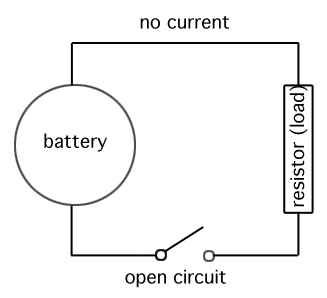
An electric circuit requires a continuous path for electrons to flow, left.


If you connect a wire to any one of the two terminals on a battery, nothing will happen. This is an incomplete or broken electric circuit. The same thing happens when you flip off a light switch in your home. The switch opens the circuit, so the current stops flowing to the light bulb. The two circles and line at the bottom of the circuit below left is a symbol for an open (off) switch. A lightbulb is an example of an electrical load. Sometimes people think that the light switches off so fast because the electrons themselves travel near the speed of light through the wire. They actually travel quite slowly, on the order of centimetres per minute. A light shuts off almost instantly because the energy of the circuit travels at almost the speed of light. This effect is similar to that observed in earthquakes and tsunamis - the energy (the wave propagation itself) travels very fast but the energy-carriers (electrons, soil/rock particles and water molecules, respectively) do not.


While a battery maintains a constant voltage, an electrical load, such as a light bulb, resistor, or motor, increases the resistance and decreases the current through the circuit. If no load is present, the current could overload the wire.

We can think of a circuit with absolute minimum load, or resistance, as a very thick wire attached to a large battery. There is almost nothing to reduce current, so a very large flow of electrons goes through the wire and the battery itself. The wire will heat up and the battery will experience increased internal resistance, as too many electrons push into one electrode and out the other one.

This can cause the battery to heat up and possibly explode, shown right. This is the danger when you accidently cross the wires when you jumpstart a car battery. If you connect the electrodes positive-to-negative and negative-to-positive, you create a circuit of a high voltage battery connected by thick wire. If we use a too thin wire instead of a thick one, we still have a dangerous problem: The wire won't be able to handle all the current going through it. A smaller wire has higher resistance than a larger diameter wire, but too much current will cause it to break down and fail. It will create such intense friction, as too many electrons try to flow through it at once, that it may melt or explode, shown below.


A highly charged thundercloud will eventually discharge through any path of least resistance. As we will see, it will make its own "wire." And when it does, there will be very little resistance (load) to slow down the rate of discharge. The lightning channel that will eventually form is surprisingly small in diameter. It is like a very thin wire attached to a very high voltage battery with no load - a powerful, and potentially deadly, electrical phenomenon.


Lightning Is A Static Discharge

The thundercloud is building up charge but no lightning has struck yet. There is no electrical current. At this point we are really talking about the build-up of static electrical charge. Static electricity is a build-up of charge in a material. There is very little flow of electrons, or current, as the charge builds up. There is, however, significant voltage.

You have probably experienced a consequence of static electricity first-hand - an electrical discharge. When you walk along a carpet floor, rubbing your feet against it, and then touch someone else you might feel (and perhaps see) a tiny spark, especially in the winter when the air is dry. The spark is called an electrostatic discharge. Lighting is an example of a gigantic spark.

Static Electricity Is A Separation Of Electrical Charge

When you rub your feet in the carpet, some of the outermost electrons in the carpet atoms are removed from it and deposited onto your feet as your feet and carpet rub together. The rubbing increases the contact (electron exchange opportunity) between the two materials. Your feet (your whole body actually) build up negative charge while the carpet becomes positively charged. You are building up electric potential energy just like a battery. When you touch someone (who is neutrally charged) the electrons will travel out through the point of nearest contact (your finger for example) into that person because there is an electric potential difference between you two. You might even see a spark cross the tiny gap between your finger and the other person.

Air is a very good electrical insulator, a material whose electric charges do not flow freely, but the tiny bit of air between your finger and the other person's body reaches a point where it can no longer provide enough electrical insulation between the increasing potential difference between the two regions of charge. There is high enough electric potential energy to overcome the resistance of the air. Current (the spark) flows and returns the system to a state of electrical equilibrium (lowering the potential energy). Molecules of water vapour in air allow electrons to move through the air more easily. In humid air, your feet still build up negative charge but water is an excellent conductor so excess electrons on your body can enter microscopic water droplets in the air and be carried away, dissipating the charge before it builds up very much. This is why electronic equipment is more likely to be damaged by electrostatic discharge when the air is dry. When air is very dry, charge can build up to a damaging voltage level before it discharges. There is no "water droplet" release valve.

You might wonder then, why the humid air around a storm cloud doesn't allow the charge do dissipate in the same way, before lighting can form. Some charge certainly does dissipate this way, as it does around waterfalls. Water turbulence allows the mist around waterfalls to acquire a negative charge that dissipates as the mist spreads through the air. Water particle movement in the air around a thunderstorm is not sufficient to undo the enormous charge build-up inside the cloud. Powerful drafts around and within a developing storm promote charge build-up.

A thunderstorm dies when the charge-building updraft mechanism weakens and is overwhelmed by downdrafts. The thunderstorm loses energy and dissipates. Charged water particles carry off and dissipate any residual charge, as opposite charges recombine once again into neutral atoms and molecules.

Why some materials, like your feet, get negatively charged and other materials, like carpet, get positively charged has to do with how the electrons are arranged in the specific atoms and molecules in those materials.

Electrons in atoms are arranged in energy shells. Only electrons in the outermost shell can be exchanged between atoms. These electrons are furthest away from the positive nucleus so they are not so tightly electrostatically bound to it. Other nearby atomic nuclei may offer enough attraction to them to get them to "jump ship." In some materials (carpet), they can be removed, especially if another material, which tends to attract electrons (feet), is in contact. Some of the atoms in your feet have sparsely populated outermost electron shells that would be more stable if one or more electrons were added to them. They attract electrons from other materials. This effect is called the triboelectric effect.

The triboelectric series, shown left, tells you which materials tend to lose electrons (positive) and which materials tend to gain them (negative).

When your feet rub against the carpet, you increase your electric potential energy (voltage). Your body wants to shed its excess electrons and it will do that if something at a lower voltage gets close enough. A Van de Graaff generator, shown below right, present in many high school physics classrooms, generates electrostatic charge, just like your feet did.

(GDFL; Wikipedia)
A demonstration model like this one can attain a potential difference of hundreds of thousands of volts, but you can touch it harmlessly because the maximum current is very tiny. As a pulley drives a belt, a positively charged tiny metal comb at the bottom sloughs electrons off the belt (usually silk, which loses electrons easily), so that the belt is positively charged by the time it reaches the top. A tiny metal comb at the top allows electrons to flow away from the outer metal dome, leaving it positively charged. When a negatively charged wand is brought close enough to the dome, a spark will jump between it and the dome, as shown below.
(Dake;Wikipedia)


Lightning is exactly the same phenomenon as the carpet and Van de Graaff generator examples, but on a much larger scale. In this case, charge separation occurs within just one kind of material - water molecules. Most researchers believe that as water drops or ice pellets fall through rising drops and pellets in a storm cloud, they experience a great deal of contact with one another. Although the mechanism(s) isn't fully understood, falling water molecules somehow gain electrons at the expense of rising water molecules. This builds up a large charge separation within the cloud, with the bottom of it becoming negatively charged and the top of it becoming positively charged.

Now that we have a handle on where electricity comes from and how it works, let's focus again on the thundercloud. Lightning is just about to strike.

Most researchers agree that water molecule-molecule contact is the root cause of charge build-up in a thundercloud. However, what kinds of movement are involved, and what kinds of objects (raindrops or rain against ice, snow or sleet) are involved, is not well understood. A scientific review paper by physicist and atmospheric physicist Clive Saunders (2008) offers several mechanism possibilities.

The top of a thunderstorm cloud, which is technically called a cumulonimbus cloud, climbs rapidly up to around 6000 m (here in Alberta) and to over 23,000 m in the tropics where the air column itself extends much higher in the atmosphere. A typical rising cumulonimbus cloud looks like the one below.

(Bidgee;Wikipedia)

At this high altitude, any liquid water present freezes and the frozen portion at the top of the cloud tends to become positively charged versus the lower (liquid) portion. Water and ice molecules behave differently in a charged environment. Although water is just one material, two of its physical states - liquid water and ice - differ very slightly in their triboelectric nature. This means that water tends to accept or lose electrons depending on its physical state. This is well documented but it seems to be very complex. Researchers also know that the molecules in ice are less densely packed than they are in water. This is why water expands when it freezes. It also means that ice exhibits something called higher static charge permeability, between 10 and 100 times higher than water due to an effect called proton-hopping. This difference could be connected in some way to cloud charging, but the mechanisms involved are far from understood.

Cloud Charge Separation Generates An Electric Field

The entire thundercloud region contains an electric field, where the potential energy of the field at any point is the electric potential energy measured at that point. Charge separation always creates an electric potential and an electric field. The field is generally negative at the bottom of the cloud and positive at the top of the cloud, but it's not necessarily uniform or straight up and down. Cloud-to-cloud lightning may occur across a roughly horizontal electric field, for example. Electrical charge is concentrated around curved objects, as we'll see, and that may add curves to the electric field. Here we are focused on cloud-to-ground lightning so this field can be represented as a series of parallel lines, as shown below right (imagine the cloud superimposed on the diagram).

The direction of cloud's electric field is downward, shown by the arrows.
An electric field exerts a force on charged particles. The black arrows on the lines right represent the direction of the force on a (test) point of positive charge. As negative charge accumulates in the bottom of the thundercloud, electrons experience an upward force. If the cloud-charging mechanism suddenly stopped, they would simply migrate upward while positive ions migrate downward and the charges would neutralize. But the charging mechanism is going full-blast, so the electrons can't move upward. Eventually, however, these electrons are going to go somewhere. They will stream down to the ground instead. Why? The electric field is negative at the bottom of the cloud, so it induces a positive charge on the surface of the ground, as shown below left. Electrons here rush deeper underground, leaving an over-abundance of positive ions at the ground surface.


Beneath the cloud, the electric field direction is reversed. Electrons want to go downward. The strength of the field's force directly depends on the amount of charge build-up. Under a storm cloud, the electric field and the electric potential become very powerful. This is why you might feel the hairs on your arms standing up. Your hair is like the carpet mentioned earlier. In an electric field, it tends to become positively charged, so it will "repel" the ground and be attracted to the underside of the cloud above you, and lift up. This is also a warning sign that you are about to be struck! It means you are in a region of extreme positive charge and lightning could strike you within seconds.


Air Resists Lightning

When charge separation builds up, the electric potential energy grows. Like any system in physics, there is a built-in push toward finding the lowest energy state possible, and nature wants to find that now. It can do it by creating an electrical discharge from the cloud to the ground. All the excess electrons in the bottom of the cloud can simply flow down into the ground, neutralizing both the cloud and the ground and eliminating the electrical potential. All this would be far less dramatic (and there would be no lightning) if air cooperated with this plan, but it doesn't.

The gas molecules in air strongly resist any movement of charge through them. The reason they resist is because the molecules created when they bond exhibit very stable electron configurations. 99% of air is composed of the diatomic gases nitrogen (N2) and oxygen (O2). Electrons are not free to move between these molecules, and they are not easily transferred between them, as they are between water molecules.

An electrical discharge is a temporary flow of electrons (or current) through a material. There is no way for electrons to flow through air when its electrons stay stubbornly fixed in place within the molecules. This makes air an excellent electrical insulator. Resistivity is a measure of how strongly a material resists electric current flowing through it.

This picture can change, however. Like any insulator, air can experience electrical breakdown if it is subjected to a sufficiently intense electric field.

The figure shown below illustrates what happens when a block of Plexiglass ® is subjected to intense voltage (an intense electric field).

(Berk Hickman;Wikipedia)

Plexiglass ® is normally a good insulator. It has a resistivity of 1 x 10¹³ ohm metres, versus air which varies between 1 and 3 x 10¹⁶ ohm metres. Plexiglass ® strongly resists any movement of charge through it. When high enough voltage (a strong enough electric field) is applied to it, it begins to break down. The electrical breakdown of the Plexiglass ® creates a beautiful hair-like discharge pattern that is thought to grow finer and finer, extending all the way to the molecular level. All the white "hairs" are where the Plexiglass ® has broken down into conductive material. It is also where an electrical discharge eventually flowed. Notice the similarity between this pattern and the fine branching of many lightning bolts.

When air is subjected to a sufficiently intense electric field, finely branched paths within it break down and become conducting paths. It does this through a series of remarkable steps.

Changes in Air Set The Stage For A Lightning Strike

Air is an electrical insulator and it exhibits a high dielectric strength. The dielectric strength of a material is similar to, but different from, its resistivity. It is a measure of the maximum electric field strength a material or gas can withstand before it breaks down and its electrical insulating properties fail. The dielectric strength of air is affected by dust, temperature, pressure and water vapour. The dielectric strength of the typical warm moist air under a thundercloud is about 3 million volts/m. Increased air pressure, for example, increases this value, while humidity (water vapour content) decreases it (remember that water is a good conductor). Tiny differences in the dielectric strength of air due to dust, humidity fluctuations, etc., might account for the intricate jagged path that lightning often takes, as if it is stepping from region to region across the sky (while generally traveling in the direction of the electric field) where resistance to its discharge flow is minimized.

We can call the cloud and the ground - two charged bodies separated by distance - electrodes. The shape of the two electrodes involved affects electric discharge. Pointy objects, like your finger and someone else's sharp elbow, make good electrodes, while flat surfaces don't. The cloud bottom and the ground are both generally poor electrodes due to their flatness, but tall pointy trees, lightning rods and the wing tips of planes, for example, change the picture. They encourage electric discharge by allowing charge to concentrate in one spot, as shown right.

This rough diagram demonstrates how a pointy or curved surface locally enhances the strength of the electric field, and the voltage, in that region and it encourages electric discharge - a spark or lightning - to take place there.

Now we're ready to get to the most exciting part,  in Lightning Part 3: The Lightning Bolt.

Monday, January 21, 2013

Lightning Part 1: Lightning Begins With a Thundercloud

Lightning is a source of endless wonder.

(smial(talk);Wikipedia)

It has been studied scientifically for centuries and yet mysteries about the mechanism of lightning remain. This makes lightning a fascinating tool we can use to explore the ins and outs of how electricity originates from the movement of subatomic particles called electrons. This subject extends quite well from the "Atoms" series in Scientific Explorer (scroll down on the right to access these articles).

There are many different kinds of lightning, some of which are rare with unworldly names like sprites, elves and blue jets. Here we will focus on one familiar type of lightning - negative strike cloud-to-ground lightning. It is not the most common form, cloud-cloud lightning is, but the cloud-to-ground lightning mechanism is better understood among experts.

Where Does Lightning Come From?

In order to understand lightning we need to start at the very beginning of a thunderstorm. To predict one, meteorologists look for three key ingredients: warm moist air, an unstable air mass and something that will trigger a rapid movement of air upward. This trigger could be an uplift of air over mountains, converging winds, or an uplifting weather front. Daytime heating tends to trigger upward air movement so most, but not all, storms occur in the late afternoon or evening.

Why is upward-moving warm moist air important? Atmospheric temperatures get colder as one travels upward. As temperatures change, materials tend to undergo a physical change, a process called phase transition. You already know this process when it comes to water: When ice is placed in a pot over high heat, it melts into water and eventually evaporates into steam. The energy of the water molecules themselves, called enthalpy, increases as water is heated, as shown in the diagram below left.

This process happens not just with water, but with many other compound materials and every elemental material as well. Even gold, which we know as a solid, melts and, if it's hot enough, evaporates into a gas. If you are curious, Wikipedia makes it easy to compare the temperatures at which various materials melt into liquid and evaporate into gas. Just look at the right-hand side of the element's page. For example, you'll see that gold melts at 1064°C and evaporates into gas at its boiling point, 5173°C. That's much hotter than lava, which is usually around 1000°C. Water can exist as liquid (water droplets), solid (ice pellets, hail, sleet, snow) and as gas (water vapour) in air.

When warm moist air lifts upward, it cools and the water vapour in it begins to condense into tiny droplets as the air reaches its dew point. The graph below right compares dew point temperature with air temperature and humidity.

(Easchiff;Wikipedia)
To understand dew point, think about dew on the lawn in the early morning. Let's say yesterday's daytime temperature was 20°C with 60% relative humidity. The dew point temperature would be 12°C, so as the overnight temperature dropped below 12°C, the relative humidity increased to 100% and water vapour condensed out of the air and fell as droplets onto the grass. Water vapour in air is continuously evaporating and condensing. When the evaporation rate equals the condensation rate, the air is at 100 % relative humidity. This means also that when the dew point of air approaches its temperature, the air has 100% relative humidity (see the darkest blue line right). Like dew on grass, clouds are regions of air where the rate of condensation of water vapour approaches the rate of evaporation.

Dew point is a good storm indicator. Warm air with a high dew point means it's humid and it has a lot of water molecules in it. Humid air is an essential ingredient in building up a thunderstorm. As this air rises, the water in it condenses and it releases energy, called enthalpy of vapourization. This energy allows the water droplets condensing out in an air pocket to cool less than the surrounding air, and this means the droplets can rise even higher. The water condensation process adds energy to a building thundercloud.

As air is swept high up in a thundercloud, the temperature can drop so fast that water vapour can change directly into tiny ice pellets, a process called deposition. This contributes even more energy to the growing storm cloud, because it releases additional energy - enthalpy of vapourization and enthalpy of fusion (the energy released when a water molecule freezes).

Gravity causes the ice pellets to fall. When they do, they collide with and sometimes stick to other pellets, growing in size on the way down. Water drops and ice pellets are carried upward in pockets of rising air and downward by gravity. This up and down raindrop/pellet motion marks the moment when the lightning-making machinery switches on. High humidity means there are lots of these drops and pellets moving in the air.

Not all lightning storms may involve the movement of ice pellets. Water droplet motion alone may be sufficient. Some researchers believe that ice formation is essential while others are not as certain. Most researchers, however, agree that the up/down motion is required to form lightning. The lifecycle of a typical thunderstorm is shown below.


The mature stage, above center, is marked by turbulence created by updrafts and downdrafts, resulting in winds, severe downpours and lightning. Next, we'll explore how water and ice movement in a thundercloud make lightning, in Lightning Part 2: Lightning Is Electricity.