Friday, January 27, 2012

Earth's Atmosphere Part 4 - Evolution of Earth's Atmosphere

Exploring how Earth's atmosphere evolved and how life co-evolved with it.

Earth's atmosphere is a complex self-regulating system that provides a protective envelope in which life thrives. Our atmosphere is not only intimately intertwined with life, it shares some attributes in common with the living, such as organization, homeostasis and evolution. It is difficult to imagine that any other planet, even of the estimated billions out there, comes even close to our own unique world. But that is the key: there are an estimated 10 billion planets that should exist within the habitable zone of their star, just within the Milky Way alone. When we think of those numbers it becomes hard to imagine that there is not any other world out there supporting life, and that there are perhaps many different kinds of worlds that support many different kinds of life.

Astrobiologists explore the theoretical possibilities of what alien life could look like. They use the immense variety of life that has evolved on Earth over the eons as a baseline comparison or a starting point to explore how different atmospheres, different gravities and different chemistry-based physiologies could, in theory, work. There is the possibility that life might indeed exist right now on another planet or moon right here within our own solar system. These are exciting questions and this is an exciting time to be curious about our atmosphere. As you will see in this article and the next two following articles, an understanding of our atmosphere, not just understanding it as it is now but how it evolved from a deadly soup of chemicals it once was billions of years ago, is key to exploring such possibilities. In this article we focus on how Earth's atmosphere took shape and evolved. As we do so, consider what kind of environments life requires and how life itself impacts those environments.

1: Where the Raw Material of the Atmosphere Came From

4.6 billion years ago, Earth started out as a ball of molten rock surrounded by a thin envelope of hydrogen, helium and a few other gases, much like all the other rocky inner planets did. This is an artist's rendering of how Earth and the other rocky planets looked as they were forming:


About half a billion years before that, a supernova exploded in the Milky Way, spewing heavy elements into a nearby cloud of hydrogen gas and interstellar dust. Under its own gravity, this mixture condensed in toward itself, growing hotter and hotter until at the center, material became so compressed and hot it ignited into a ball of ongoing nuclear fusion, and our Sun was born. The Sun's ignition was itself a gigantic explosion, blowing most of the dense cloud of dust around it, called the accretion disk, away, with lightest elements blowing furthest outward. By this time, clumps of this dust had already begun to clump together under the attractive force of gravity, a process called accretion.

Earth was simply the result of this accretion of the elements that were most abundant within its zone of the Sun's accretion disk (shown above). Inner planets formed mostly from heavier elements (metals) and more distant planets formed from lighter elements (ices and gases). This 48-minute NOVA video shows how Earth was made from this gas and dust:


2: Setting Up Conditions Favourable For Producing and Maintaining a Complex Atmosphere

Molten-ball Earth didn't simply settle down and cool to form our present-day atmosphere. A series of events had to take place to set the stage for its development. The most important event of all was the formation of an enveloping magnetic field. Without it, all of Earth's atmosphere would have been stripped away by the Sun's intense solar wind soon after it formed. Another important event was the formation of an atmosphere very different from what we have today. This first atmosphere was the cradle of all life on Earth, and yet it is not anything we would want to breathe - we would immediately be both poisoned and asphyxiated by it. Let's look at these events in more detail.

Earth didn't start out with a magnetic field. It was simply an unorganized amalgam of rocky fragments of rocky meteorites, metallic fragments of metallic meteorites and icy fragments of comets, all material from the accretion disk. To create a magnetic field, Earth required organization into an inner core of swirling molten conductive metal.

This sets up a dynamo, shown below, which creates a large magnetic field:


That kind of density (and composition) stratification took time. As Earth grow in mass, it eventually became large enough to create internal heat sufficient to melt entirely so heavy molten metals could gradually sink through lighter material into the center of the planet, a process called the iron catastrophe. Meanwhile, Earth's first atmosphere, technically a tenuous exosphere, the result of outgassing mostly of the two lightest elements, hydrogen and helium, from its molten rock, had no magnetosphere to protect it so it blew away with the intense solar wind estimated to be a hundred times greater then. Eventually, the magnetosphere, a large protective magnetic envelope that deflects incoming solar wind, developed and offered some protection:


In this diagram the solar wind flows from left to right.

Over the next 200 million years, Earth eventually cooled enough to form an inner molten metallic core and solid lighter rocky crust. This young Earth was still extremely hot for three reasons: It had a greater abundance of radioactive elements then, it was constantly bombarded by all the debris that littered the early solar system, and it experienced intense gravitational stresses from other planets and moons developing nearby jostling around each other in unstable orbits. Earth, surrounded by orbiting solar debris and a young moon (not shown) might looked something like this at that time:


By about 4 billion years ago, Earth had differentiated into a its present-day structure, with an iron-rich metallic core, a less dense magnesium-silicate mantle and a relatively thin light crust composed mostly of silicates (rocks). Lighter water was also present on Earth by this time and a new atmosphere was forming above that, shown here:


It was still not a peaceful time, however. Large meteorites continued to rain down and gigantic volcanoes, spewing toxic chemicals, littered the surface, while the young Sun blasted Earth with intense ultraviolet radiation. The surface of Earth may have looked something like this:

Credit: David A. Aguilar (CfA)

The  Moon was much closer to Earth then, as shown in this image.

3: Earth's First Atmosphere Was Nothing Like Today's Atmosphere

Gravitational stresses led to extreme volcanism, and this is where Earth's first atmosphere came from. Contemporary volcanoes, however, do not expel the kinds of gases that most researchers believe must have been present in Earth's first atmosphere. Volcanoes today release lots of water vapour, carbon dioxide and sulphur dioxide but they do not release ammonia (CH3) or methane (CH4), two reduced gases, in any appreciable amount.  As a result, modern volcanic gases cannot create a reducing atmosphere and a reducing atmosphere is essential for producing the most fundamental building material of life, organic compounds. An organic compound may be strictly defined as any molecule that contains carbon. In this article, we will define an organic compound much more narrowly - it must contain a carbon hydrate, a carbohydrate in other words, consisting of carbon, oxygen and hydrogen, examples of which are shown here:

(copyright chemistryland.com, an excellent primer on organic chemistry)

These compounds, for example carbohydrates, lipids, proteins and nucleic acids, are all molecules associated with life processes. In living organisms they are synthesized inside cells, which are reducing environments.

In a reducing atmosphere, there is no oxygen but plenty of hydrogen. Scientists have been challenged with trying to figure out what Earth's earliest volcanoes spewed out and they have attempted to recreate plausible early Earth conditions in which organic compounds could be produced. The Miller-Urey experiment, shown below, conducted in 1952, provided evidence that organic compounds could be synthesized from inorganic precursors under conditions that are thought to resemble Earth's primitive atmosphere.

(copyright: YassineMrabet (Wikipedia))

Recent refinements of this experiment have further confirmed these findings by showing that a large variety of different amino acids are formed in an environment rich in methane, water, ammonia, carbon monxide and hydrogen that is energized by an electric current (recreating abundant volcanic lightning).

To further confirm these findings, scientist Bruce Fegley recently turned to chondrites, primitive meteorites (shown below), for answers.

(copyright: H.Raab (User:Vesta)(Wikipedia)

 Chondrites are stony chunks of rock that were never modified by melting or differentiation in any way since the solar system formed. They are accretions of solar dust that are composed of exactly the same material that comprised early Earth. All he needed to do was to heat them up and collect all the gases that are released, as minerals inside them react with each other and decompose. For example, when the mineral calcium carbonate is heated up it decomposes into carbon dioxide gas. When this chondrite-outgassing mixture is exposed to an electric current, recreating Earth's early lightning-rich atmosphere, a reducing mixture is created and simple organic compounds form. These findings imply that the composition of Earth's outgassing, through volcanoes, has changed significantly over time, and that these changes contributed to Earth's atmospheric evolution.

The hydrogen budget, the redox budget in other words, of Earth's early atmosphere is essentiall to understanding its early composition, and critical to figuring out how organic compounds, precursors to life, formed. A reducing environment is also critical for making amino acids, as shown here:

(copyright chemistryland.com)

Organisms use amino acids to build proteins. There are many different kinds od amino acids, each of which contains an NH2 base group, a -COOH group and a hydrogen atom, all attached to a carbon atom. Ammonium ions are required to make amino acids and these can only exist in a reducing environment.

4: From Organic Molecules to Organized Structures

Nucleic acids also formed under these atmospheric conditions and they could catalyze the construction of the first proteins out of amino acids. Nucleic acids (RNA and DNA) are polymers of nucleotides. The basic structure of a nucleic acid is shown here:


Some researchers believe that RNA was the first nucleic acid to be formed. An example of pre-messenger RNA (a chain of nucleotides) is shown here:

(Copyright:Vossman (Wikipedia))

Each nucleotide is composed of a nucleobase (shown as green) and a phosphate-sugar back backbone (blue).

RNA's first function may have been to act as an enzyme catalyzing the polymerization of amino acids into proteins. Later, it evolved the ability to store, transmit and duplicate genetic information. Ultraviolet light, abundant on early Earth, causes RNA to polymerize, while it breaks down other organic chemicals that could potentially break down RNA. The first simple RNA-mediated protein chains could be considered primitive life forms in the sense that different forms could compete with each other, with the ones that can most efficiently catalyze their own replication having a selective advantage over the others. Some viruses still use RNA as their genetic material. There is some question as to whether viruses are a life form or not, and the same criteria could be applied to the ancient RNA polymers. Neither have a cell structure. Nor do they have their own metabolism.

The experiments of Sidney Fox have shown that organic compounds can spontaneously aggregate together and surround themselves with a membrane-like structure under conditions similar to those on early Earth. Slightly more complex structures are called protobionts. They exhibit some properties associated with life such as simple reproduction, metabolism and excitability as well as the maintenance of an internal environment. Nanobacteria could be examples of protobionts.

The most primitive non-disputed living organism is the prokaryote; its body plan is shown here:


Most researchers believe that more complex DNA evolved from RNA within some kind of protected environment, as DNA is sensitive to damage by UV radiation. Prokaryotes lack a cell nucleus or any organelle. They are simple sacks that reproduce using a free-floating DNA-protein complex and carry out metabolism across their membrane. Many can form aggregate communities and it is through this kind of social aggregation that more complex eukaryotic organisms may have evolved. Single cell eukaryotes evolved into the complex multicellular life that exists (along with the simpler forms mentioned) on Earth today.

5: What Drove the First Life Into Being? - A Perplexing Entropy Question

That organic compounds can form into more complex molecules and arrangements is all but verified by the experiments mentioned above and others. The question of why they do so is left for us to explore.

All physical processes are driven by entropy. Reactions always favour the movement toward a lower energy state. According to the second law of thermodynamics, the entropy of a closed system therefore tends to increase.

Let's first explore what a chemical reaction is, so we can probe the thermodynamics of life. Any chemical reaction can be spontaneous, requiring no input of energy, or non-spontaneous, requiring energy input such as electricity, light or heat. A chemical reaction may require a catalyst, such as an enzyme, in order to increase the reaction rate, and this is the case for almost all biochemical reactions that make up the metabolic pathways of living organisms. Most chemical reactions are reversible, with each direction competing with the other and differing in reaction rate. The direction of a reaction depends on many factors, external conditions such as heat or the concentration of reactants available, for example. Most reactions eventually establish a point of equilibrium at which reactions in each direction balance out. At this point the Gibbs free energy of the system is zero. Gibbs free energy is a thermodynamic term, which means the ability to do non-mechanical work. In a closed system, a reaction tends toward a lowest possible energy state, in other words. A reaction will spontaneously proceed if it is exergonic, that is, it releases energy. A reaction can also consume energy, and in doing so it decreases the entropy of the system. In the case of many of the synthesis reactions described here, electrical energy is converted into chemical bond energy. In doing so, the entropy of the product, for example an amino acid, is lower than that of the total entropy of the reactants, ammonia and acetic acid for example. A more ordered arrangement is created. If we extrapolate to a living organism, its highly ordered arrangement of molecules is maintained through the processes of metabolism and all those reactions involved require an input of energy (from the Sun or food for example). When an organism dies, metabolism ceases and the molecules of its body return to a disorganized state through decomposition. According to the rules of thermodynamics, the entropy of the remains increases until a new overall (lowest energy) equilibrium point is reached.

This is how the thermodynamics of living organisms works. It describes the behavior of the various components of that system very well. Yet you may still question the thermodynamics of life from a larger holistic perspective. Its an excellent question, and when we try to describe the intricate relationship between Earth's atmosphere and life on Earth, we may very well begin to wonder if there must be some divine input involved. Can the intricate relationship between Earth and life by explained by science? The answer to this question will necessarily impact how you ask questions about life in the universe in general, and about the universe itself. As a scientific explorer, I recommend that as you grapple with these questions, keep an open mind and use your developing skills of deduction, reasoning and researching to guide you. We have explored how the chemistry of synthesis obeys the second law of thermodynamics. Yet it may still seem that the general self-organizing nature of life breaks this fundamental law. This organizing nature is called emergent behaviour.

You may recall from my article on atmospheric structure that small pockets of air of different densities can and do organize into more complex systems such as thunderstorms. This is called an emergent property of a complex system. The formation of our Sun and planets from a giant cloud of dust is another example. We can even say that the entire universe is increasing in order and decreasing in entropy, at least from our viewpoint. And viewpoint is the key to understanding the entropy of systems. If we consider the self-organization of life to be a more open system to include energy inputs, we can see that electrical energy from lightning as well as solar energy were expended in order to increase the complexity of organic molecules into systems capable of interactions with each other and of self-replication. Once this occurred, the process of natural selection can be used to explain how further complexity evolved. But let's step back for a moment - It is precisely the point where a system of biochemical reactions acquires the capacity to interact with other systems, and to replicate, to be alive in other words, that many people continue to wonder about. What force could drive this acquirement?

The energy of the Sun is behind the development of complex weather systems. Gravitational energy is what ultimately organizes dust into stars and planets. And perhaps it is possible to say that the universe continues to draw on the energy of the Big Bang as its overall complexity continues to increase. There is a great deal of discussion going on among experts and laypeople alike about how life may have developed as an emergent property of matter and the question is not only ultimately still open, but it invites philosophical and religious debate. As scientists continue to refine experiments that attempt to recreate the self-organization of non-living organic aggregates into primitive but living cells (and continue to refine how life is defined), some day perhaps we may be satisfied that all the processes leading up to the living Earth as it is today are driven entirely by physical forces in the universe. However, we may be left with yet another unsettling question: How did a universe with an inherent capacity to bring forth life come to be? With that, I will leave the topic of how life formed, having barely scratched the surface of a deeply fascinating puzzle.

Protobionts, viruses and viroids (much simpler than even viruses and perhaps one of Earth's best examples of biological organization at the knife edge of life) give us possible clues as intermediate steps toward increasing organization, and where non-living becomes living. Eventually, very simple life forms called prokaryotes evolved. The oldest fossilized example dates back 3.5 billion years, just 1 billion years after Earth itself formed. It is a fossil of cyanobacteria inside ancient rocks in Western Australia:


This is an Australian fossil of filamentous cyanobacteria that is about 850 million years old. These simple organisms hold one of the most important keys to understanding how Earth's atmosphere evolved, as we will discuss next.

Molecular biomarkers in rocks (oxygen bound up in limestone, iron and other minerals) about 2.4 billion years old indicate photosynthesis by this time was well spread.

6: Photosynthesis Makes Earth's Atmosphere Unique

The evolution of photosynthesis is what really changed Earth's atmosphere into what we have today. Early Earth was colonized by many different kinds of prokaryotes, a group which is divided into two domains - bacteria and archaea:
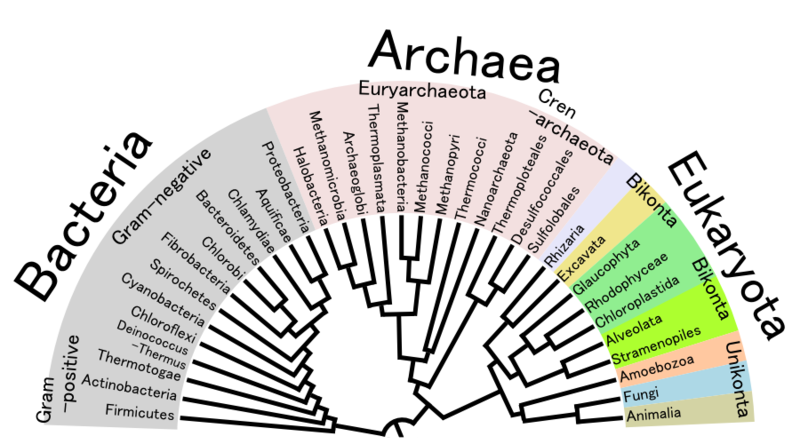
(copyright: Bacterial/Prokaryotic Phylogeny Webpage (Wikipedia)

Prokaryotes have been found in every kind of habitat on Earth. One kind of prokaryote, cyanobacteria, while very tiny as individual organisms, multiplied into great numbers and changed the entire atmosphere of Earth. These organisms evolved from the simple prokaryote bag-of-chemicals plan into a more elaborate system of enclosed membranes that can carry out photosynthesis. They are tiny factories that use the Sun's energy to manufacture carbohydrates. Neither chloroplasts nor chlorophyll had yet evolved. Cyanobacteria then and today do not have any distinct organelles like the more advanced eukaryotes do. These organisms instead used a bluish pigment called phycocyanin to capture sunlight energy. In doing so, they sequestered carbon dioxide into carboydrates and released oxygen gas as a byproduct. As oxygen built up, the atmosphere changed from a reducing one to an oxidizing one. All the surface minerals on Earth were eventually oxidized, saturated with oxygen in other words, changing Earth's geology and resulting in thousands of new minerals. Once minerals were saturated, oxygen gas began to accumulate in the atmosphere. When the atmosphere was reducing one, iron and other metal ions would have been dissolved in seawater. When oxygen became abundant, it oxidized these ions, resulting in insoluble iron oxide compounds, which fell out of solution as sediments.  Most of the iron mined today for example, comes from these ancient sea bottom sediments. These deposits are generally no more than 2 billion years old, indicating that it took a long time for the atmosphere to become oxidized, about 1.5 billion years from the first fossil evidence of cyanobacteria.

Cyanobacteria released oxygen as a poisonous waste gas. These bacteria did not poison themselves because they evolved protective enzymes that could eliminate the DNA-damaging hydroxyl radical that forms during the production of oxygen. Anaerobic bacteria, bacteria that require an oxygen-free environment, had also evolved by this time and had colonized much of Earth. When free oxygen began to accumulate in the atmosphere, most (but not all - these organisms were very successful in finding various new niche environments including our own bodies) of these organisms died, precipitating Earth's first major extinction event.

As oxygen gas accumulated, Earth's atmosphere underwent a global redox reaction. Meanwhile, highly resourceful cyanobacteria continued to etch out new ecological niches. They now inhabit almost every habitat on Earth, even existing as endosymbionts inside lichens, plants, protists and sponges, providing energy for the host organism. Cyanobacteria contributed approximately 10% of today's oxygen level during the Precambrian period, and it probably fluctuated wildly. Today they continue to contribute significantly to the atmospheric oxygen pool. These very simple organisms can live as single cells and as colonies of cells, which can form filaments, sheets and hollow balls. They are important primary producers in ocean food webs. Some filamentous colonies can even differentiate into several different cell types, each one adapted to a different living environment. Normally photosynthetic, these cells can differentiate into tough spore-like cells and it is these cells that can fix nitrogen gas into ammonia, nitrates and nitrites, as well as survive long harsh periods such as glaciation events.

Nitrogen fixation paved the way for the next explosion of life on Earth - plants. Plants improved upon the simpler kind of photosynthesis cyanobacteria use by evolving chloroplasts, highly efficient solar energy capturing systems. In fact, there is evidence that chloroplasts evolved from an ancient endosymbiotic relationship with cyanobacteria. Plants significantly increased the level of oxygen in the atmosphere as they evolved and colonized the planet.

Atmospheric oxygen oxidized methane (a strong greenhouse gas) into carbon dioxide (a weaker greenhouse gas), triggering the Huronian glaciation event beginning about 2.5 billion years ago, the first and most extreme of a series of global glaciation events, this one lasting up to 400 million years. By this time, a protective ozone layer was forming as oxygen was broken down high up in the atmosphere. Volcanic activity continued to pump out various greenhouse gases, ultimately rewarming the surface and bringing an end to the glaciation. Glaciation cycles continued, but life survived the extreme conditions and eventually some aquatic organisms grew complex enough and, thanks to the ozone layer protecting them from deadly UV radiation, were to colonize land. An explosion of plant life caused oxygen's atmospheric level to spike around 550 million years ago at about 35% (today oxygen makes up about 21% of our atmosphere). These high oxygen levels may have contributed to an explosion of new organisms called the Cambrian explosion as well the massive sizes of amphibians, dinosaurs and the first insects to follow.

7: Earth's Atmosphere - Unique AND Ordinary?

What is perhaps most intriguing about the history of Earth's atmosphere is that there is nothing very unusual about the physical processes that provided the material and environment for life to organize and form. Yet how life began to create its own environment does seem extraordinary. This leads us to a pressing question: If life started here on Earth, why didn't it start on other planets in our solar system? They all had the same raw materials (at least Venus and Mars formed at similar distances from the Sun did they not?) And further still, shouldn't other protostars have formed of similar ancient star debris and shouldn't other planets just like Earth exist out there? These questions will be explored in upcoming articles.

8: Where Did All The Nitrogen Come From?

Earth's atmosphere contains more nitrogen than any other gas. Where did it come from? Surprisingly for a gas that makes up almost 80% of Earth's atmosphere, no one is entirely sure, but some researchers believe it may have been formed through transmutation of atmospheric carbon and oxygen between about 3.8 and 2.5 billion years ago, caused mostly by neutrino bombardment from the young Sun and from violent volcanic activity. Others compare nitrogen to oxygen and conclude that atmospheric nitrogen is so abundant simply because it is not easily incorporated into rocks and it is very stable, so it has accumulated gradually over the eons.

If ammonia was significantly present in Earth's early atmosphere, nitrogen could have come from its decomposition in the presence of UV radiation (which would have bombarded the young Earth). When life evolved on Earth, nitrifying bacteria could act on ammonia to produce nitrites for plant growth. Other denitrifying bacteria could add nitrogen gas to the atmosphere. Nitrogen is an almost entirely inert gas so it is generally not taken back out of the atmosphere by binding with other elements. This means that even small contributions if continuous, could add up to all the nitrogen in the atmosphere today. Because nitrogen is inert, it is difficult to estimate when it began to make a significant contribution to the atmosphere, as there are few if any chemical markers in ancient rocks, for example, to use. Other bodies in our solar system, particularly Titan, have significant nitrogen atmospheres but as we will see in a future article, the mechanisms responsible are likely far different.

9: Conclusion

When we consider how Earth's atmosphere evolved, the co-evolution of life must be taken into account in order to explain many of the complex changes that have occurred. A constantly evolving complex interrelationship between life and the atmosphere exists in which one both depends on, and alters, the other. Although this article focuses on the atmosphere, I hope I have provided a starting point from which to explore the mystery of life in general as well.

We will continue to build on our questions about life by comparatively focusing on the atmospheres of Venus, Mars and a very interesting moon, Titan, with the goal of further deepening our appreciation for the unique atmosphere of Earth, next.

Sunday, January 22, 2012

Earth's Atmosphere Part 5 - Comparing Mars And Venus To Earth

Now that we have an understanding of Earth's atmosphere, we can look at what kind of atmospheres evolved on some other bodies in our solar system. The planets and dwarf planets are shown here:


Sizes are to scale (but not distances); the Sun is to the left.

Keeping in mind that everything in our solar system is composed from the same raw materials (elements created in a supernova) but with a general outward trend toward lighter elements, we can begin to study how an object's mass, impact history and other features help determine the acquisition and evolution of an atmosphere.

Fortunately our solar system provides us with two planet-size laboratories, Venus and Mars, shown here in this composite image of all four rocky planets:


From left to right are Mercury, Venus, Earth and Mars, with relative sizes shown to scale.

Both Venus and Mars are rocky planets of the inner solar system. Venus (0.7 AU) is closer to the Sun than Earth (1 AU) and Mars (1.5 AU) is farther away. Exploring how they evolved as planets with atmospheres quite different from Earth's atmosphere can help us understand the processes involved in the evolution of our own atmosphere.

The Entire Solar System Formed From A Cloud of Gas and Dust

Let's begin by revisiting how planets and moons form. When the Sun ignited into a ball of nuclear fusion, the dust and gas and larger clumps of matter that had already accreted because of mutual gravitational attraction, the protoplanetary disk in other words, shown below, experienced a variety of forces.


The outward force of the Sun's fusion reaction, technically called radiation pressure, would have been proportional to the cross-sectional area of each particle in the disk. At the same time, the gravitational attraction of the particles to the Sun would be proportional to the mass of each particle. This means that the smallest bits of dust and gas moved away from the Sun into slower outer orbits while conserving their angular momentum.

Angular momentum is the product of the linear momentum of a particle and it position vector. The animation below helps describe this quantity for any object with a fixed mass rotating around a fixed axis:


The little lilac r represents a force called torque. Force is the dark purple F, linear momentum is the small green p, and angular momentum is the light green L. Having a basic sense of angular momentum will help you understand why all the planets orbit the Sun and why they spin. It is always conserved in systems and that is why a skater will spin faster when she draws in her arms, for example.

Larger clumps, moving in closer faster orbits captured this dust and gas with every orbital sweep, building up mass and angular momentum. Eventually rapidly spinning planet and moon-size clumps formed. As these bodies formed, their orbits experienced resonant interference from other orbiting bodies. Gravity tends to push two or more bodies of similar masses into resonant orbits but ejects them if their masses are dissimilar enough. For example, Neptune and Pluto are in a 3:2 orbital resonance with Neptune making 3 orbits for every 2 orbits Pluto makes. Even though their orbits cross, they will never collide, thanks to this kind of stabilization. However, an asteroid coming into a resonant orbit with Jupiter (much more massive) will tend to be quickly shot off. Smaller orbiting bodies in orbits similar to a larger body would eventually be overcome by the faster orbiting larger body with the larger body acquiring the new mass or the smaller bodies being acquired as satellites (moons) of the larger body.

It is the above process that determines the initial elemental composition of each orbiting body, but keep in mind that formation is not yet entirely complete. Planets and moons could have impacted with each other or asteroids or comets and acquired new orbits closer to or further away from the Sun. Thus the composition of the planets today does not necessarily reflect a perfectly smooth progression toward lighter element make-up. The young solar system would have had many more comets and asteroids than it does now, all clumps of material that did not quite yet coalesce into planets or moons. Perturbations of planetary orbits as they interacted with each other as well as gravitational forces from other stars pulled comets into highly elliptical orbits and they regularly crashed into other orbiting bodies. Comets are compositionally diverse, meaning that they originated at different distances from the Sun. Contributions by comets therefore needs to be considered as well when comparing the compositions of the planets. Asteriods tend to be more compositionally similar to each other. They may be clumps that never formed planets as well as fragments from collisions between forming planets. They fall into three classes based on their composition, those rich in carbon, silicon or metals. There is much evidence that the rocky planets such as Earth, Mars and Venus, are composed of the aggregation of these asteroids.

The heat from the young Sun would have also had a huge impact on the composition of the planets. Planets forming close to the Sun would have received a great deal of heat from it. When the Earth was forming the temperature of hot gases and dust populating the solar system near its orbit is estimated to have been between 800°C and 1400°C. Near the orbit of Mercury the temperature would have been far greater. Even the temperature of the asteroid belt, orbiting between Mars and Jupiter, would have been several hundred degrees above zero. The kinds of compounds that could form out of the elemental raw material of the protoplanetary disk would have been highly dependent on temperature. Where Earth formed, only high melting-point metal oxides and silicate minerals could survive. Much of Earth's original volatile compounds and gases would have boiled away into space. However, far from the Sun not only could these minerals, but more volatile carbon compounds and ices as well, could form. There, highly volatile gases like methane could exist without boiling away from the body's surface. This is why there is a great variation in the composition of the solid material making up the planets today. It is also why a planet further from the Sun such as Mars can and does contain lower melting-point minerals such as carbon rich compounds, than Earth does, and why carbon-rich asteroids are more abundant in the outer reaches of the asteroid belt and metal-rich ones dominate the inner reaches.

Newly forming planets were also heated and reheated by countless high-velocity collisions. Not only were the velocities of orbiting asteroids and comets already significantly accentuated by the gravitational pull by the Sun, they were also accelerated by the gravitational pull of the planets themselves as they approached them before impact. These forces would have resulted in spectacular collisions that could partially or even entirely melt a planet.

The young solar system would have also been much more radioactive than it is now. The supernova that created all the gas and dust from which the planets formed created mostly light elements such as helium and hydrogen but it also created heavier elements and even small amounts of massive unstable elements with short half-lives. As these elements decayed into more stable isotopes, they released heat inside the forming planets.

Planets and moons of sufficient mass are also heated by compression, by the gravitational inward pull of their own material in other words. The inner cores of the gas giant planets such as Jupiter are thought to have been intensely hot, as high as 140,000°C. Although they would have cooled since then, much of that original heat remains. Tidal forces, forces exerted by the gravitational pull from other large bodies nearby, also deformed and heated planets. With many collisions and unstable orbits within the young solar system, these forces may have been extreme.

Planets Differentiated as They Formed

When we consider how atmospheres formed on the young planets, we must take into account not only the various sources of their initial elemental make-up but also how they differentiated. The material making up a planet will separate according to density with the densest material sinking into the core and lighter materials floating up to the surface, as long as the planet remains in a sufficiently molten state. The amount of differentiation that occurs depends largely on how thoroughly molten a planet was when it formed as well as how many times it re-melted as a result of subsequent impacts. Earth has the highest density, the highest mass and the fastest rotation of all the rocky planets. It is also probably the most highly differentiated. It remained molten long enough to differentiate into a distinct outer and inner core. The outer core is very low viscosity liquid nickel and iron that surrounds a solid inner iron-nickel core. There is some evidence that the inner core is actually freezing out of the surrounding core as the Earth's interior gradually cools. All the rocky planets have a well-defined crust, mantle and core, but we don't know much about the composition and physical state of Mars' and Venus' cores.

Not all of the lighter gases and compounds making up the just-formed rocky planets boiled away into space. Some remained trapped inside them, dissolved in molten rock, much like gases dissolved in magma inside volcanoes. These gases had a second opportunity to escape while the planets remained in their molten state, through a process called outgassing. Solar wind from the young Sun would have blown most of these gases away as they were released, but the gravity of some of these rocky planets would eventually hold onto heavier gases, such as carbon dioxide, that outgassed from their interiors. Both carbon and oxygen were fairly abundant in the region where the rocky planets formed. Earth, Venus and Mars were probably all initially blanketed in a CO2-rich atmosphere as well as significant amounts of outgassed water vapour. Today, however, CO2 accounts for only 0.035% of Earth's atmosphere whereas it accounts for almost all of Mars' and Venus' atmospheres, 95% and 96% respectively. Why?

Earth's Liquid Surface Water Offers Clues and Questions

No one is entirely sure how Earth acquired a significant amount of surface water soon after it formed. There is some radioisotope evidence that water-rich meteorites (these would have been protoplanets that struck young Earth) contributed significant water to our oceans. The process of photosynthesis creates water as a byproduct and this could have contributed water over time but its contribution would have been well after Earth was blanketed by liquid water. Like the other young planets Earth would have had a significant amount of water in the material that formed it, but most experts believe it is not enough to account for the amount in our oceans today.

There is another mystery associated with Earth. It should have more noble gases in its atmosphere than it does, based on their abundance in the raw material that formed it. Like carbon dioxide and water, some of these gases should have been retained by Earth's gravity as they outgassed from its interior. Their lack suggests a catastrophic impact may have shot them away into space. This may have been an impact with another large (about Mars' size) forming planet that resulted in Earth's re-melting and the formation of the Moon from the orbiting leftover debris. That impact is shown here in this artist's depiction:


The impact, estimated to have occurred around 4.5 billion years ago, would have left a temporary atmosphere consisting of rock vapour, lots of carbon dioxide and light volatiles like hydrogen gas. This atmosphere would have been heavy enough to create a surface pressure sufficient to maintain liquid water oceans even with an estimated surface temperature of 230°C, shortly after impact. Water could have been contributed by the impacting protoplanet. Regardless of the continuing mystery of the ocean's origin, studies of zircon minerals suggest that liquid water existed on Earth's surface as long ago as 4.4 billion years ago, just 600 million years after Earth itself formed. Recent radioisotopic studies of hydrogen isotope ratios in comet minerals make a significant contribution of water from comet impacts unlikely, greatly weakening a long-held theory that water-rich comets contributed to Earth's oceans.

The early existence of surface liquid water played a very important role in Earth's unique atmospheric evolution. Carbon dioxide is very soluble in water. Much of Earth's carbon dioxide would have dissolved in its oceans to react with minerals and form compounds like silicon dioxide and limestone. Much of Earth's carbon dioxide became sequestered in its rocky crust, taking it out of the atmosphere.

A Comparison Between Mars, Earth and Venus

Mars, Venus and Earth are all rocky inner planets that shared similar formation histories, and yet the atmospheres of these three planets are so different from each other. This is an image of the thin atmosphere of Mars taken by the Mars Rover:


Here is an artist's conception of Venus's crushing atmosphere:


Compare the above images to Earth's blue life-giving atmosphere:


Let's examine the origin histories of three atmospheric gases that vary greatly between these planets to get an idea of what happened.

Nitrogen

Earth's atmosphere is composed mostly of nitrogen and oxygen. We know from looking at its evolution that oxygen in Earth's atmosphere is unique. Oxygen is highly reactive and if it were not continuously released into the atmosphere by plants through photosynthesis, this gas would quickly disappear through reactions with metals and other crust elements. It would be sequestered in rock. As mentioned in the atmosphere composition article, Earth's atmosphere is 78% nitrogen. Although no one is quite sure through which processes Earth acquired all that nitrogen, both Venus and Mars appear to have (or had) similar mechanisms for creating nitrogen-rich atmospheres. Nitrogen has an atomic weight similar to oxygen, but it is almost completely nonreactive, which means that it could have simply built up over the eons through outgassing from the planet's surface and, at least on planets with as much gravity as Earth, it would be heavy enough not to be lost to space. Although Venus' atmosphere is almost all carbon dioxide with only a relatively small amount of nitrogen, that small amount is roughly four times more than Earth's. Venus is roughly the same size as Earth but it experiences much more volcanism. It therefore has had a greater source of outgassed material and this could explain why it has much more nitrogen than Earth does. Venus' atmosphere is simply much denser overall than Earth's atmosphere. Mars, on the other hand, has only 3% nitrogen and a far thinner atmosphere than Earth does. The surface air pressure on Mars is less than 1% Earth's surface air pressure. If Mars started out with similar raw ingredients, where did most of its atmosphere go and why is it so low in nitrogen? One clue comes from isotopic studies of the nitrogen on Mars. It contains a higher proportion of heavy isotopes than Earth's nitrogen does, suggesting that many of the light nitrogen isotopes have escaped its atmosphere. Perhaps Mars at one time had a nitrogen content similar to that of Earth but its low gravity (0.38 g) cannot hold onto it.

Water and its Connection To a Magnetosphere

Water was abundant in liquid form on Earth soon after the planet formed, and it continues to be abundant. Mars, however, currently cannot support liquid water on its surface. What little water it has (0.03 % of its atmosphere compared to 0.4% of Earth's atmosphere) is locked up in permafrost and in its polar ice caps. Its extremely low air pressure means that any liquid water would rapidly evaporate (or sublimate as its surface is on average -55°C). There is a great deal of evidence that Mars had significant amounts of surface liquid water in the past, perhaps billions of years ago. There is geographical evidence of ancient lakes and rivers, meaning that it once snowed and rained on the small planet. There is some evidence that highly salty water may currently exist temporarily in small areas before it freezes on the cold surface. And there is also evidence that past volcanic activity on Mars could have released enough water vapour to put Mars on average 120 metres under water and create a carbon dioxide-rich atmosphere twice as thick as Earth's. Such an atmosphere would have been warm enough to support liquid water released from the volcanoes. Mars may have once been much like Earth was billions of years ago, with surface water and a warm atmosphere.

Unlike Earth, Mars had some factors working against the retention of its atmosphere and surface water. It has less gravitational pull on its gases (about 0.38 g) than Earth does. And, unlike Earth, it did not maintain a magnetosphere that protects its atmosphere from solar wind erosion. Like Earth, Mars' atmospheric gases have been regularly replenished through volcanic activity, although eruptions on Mars are thought to be less frequent and more massive than those on Earth, largely due to Mar's lower gravity. With no protective magnetosphere, its volcanic activity was not enough to balance out atmospheric loss by solar wind.

The lack of a magnetic field gives us some clues that Mars differentiated differently than Earth did. Recall that the magnetic fields of the rocky planets are the result of the circulation of liquid metals within their cores. There is evidence that Mars underwent differentiation like Earth did, and current models suggest Mars has an iron/nickel/sulphide core that is partially fluid, with about twice the concentration of lighter elements in it than Earth does. Although Mars does not have a current magnetic field, parts of its crust have been magnetized in the past, suggesting that it once did have a core dynamo. At some point billions of years ago the dynamo stopped functioning and the magnetic field faded away. Mars' atmosphere was blown away by solar wind, transforming it from a warm wet world into the inhospitable planet it is today. Why Mars' dynamo failed is still a mystery. It was once thought that Mars' core simply solidified, as it is a small planet and therefore it probably cooled more rapidly than Earth did (this implies that Earth's dynamo is too destined to eventually fail as Earth continues to cool). Recent evidence of an at least partly liquid core within Mars complicates this theory. The result, however, demonstrates how important a magnetosphere is to maintaining an atmosphere. Or does it?

Let's examine the magnetosphere of Venus. Venus's atmosphere is incredibly dense (its surface pressure is about 90 times higher) than Earth's. Perhaps Venus has more volcanic activity to pump out more gases and an even more powerful magnetic field to help keep them all in.

Unlike Mars, we do not have seismic data about the internal structure of Venus. However, geologists expect Venus' similarity to Earth in size and density point to a similar internal structure with an at least partially molten iron-rich core that should be capable of sustaining a magnetic dynamo. It doesn't. Like Mars, no one is sure why, but there may be two reasons for this. First, in order to create a dynamo, molten metals must be rotating. The rotation of these metals should be directly linked to the planet's rotation. Earth rotates relatively fast (once every 24 hours) compared to Venus, which rotates only once every 243 Earth days. Second, Venus shows no signs of plate tectonic activity. Plate tectonics is a theory that describes the large-scale movement of planetary crust material. It builds on the concept of continental drift. Venus' rotation is also in the opposite direction compared to all the other planets except Uranus. Its lack of plate tectonics and odd rotation may point to a catastrophic collision some time in Venus' past. This is a fairly old theory that has been weakened by a lack of debris left behind, a moon or two for example, as evidence. However, some theorists are revisiting the impact theory to explain Venus' odd rotation.

Scientists now wonder if plate tectonics may be another requirement for a dynamo set-up. The shifting of crust plates may act to cool the mantle and create a large enough temperature difference between the mantle and the core to drive convection. This convective movement may also contribute to a dynamo.

Mars rotates once every 24.6 hours so this is not likely the reason why it has no dynamo. Still, Mars, like Venus, shows no sign of active plate tectonic movement. There is some evidence of striped patterns of different directions of magnetism in Martian rock and this could have been created by early tectonic activity that has since ceased.

Tectonic activity has been active on Earth since it was formed. There is much evidence for current activity, for example in spreading seafloors. On Earth this movement is possible because Earth's crust has a higher strength and lower density than its underlying mantle. Although there is some debate about what motor drives this movement, most agree that convection in the mantle is at the root of it. Interestingly, this means that mantle convection may be involved in both the cause and effect of plate tectonic movement.

One theory about why Earth continues to undergo plate movement while Venus and Mars do not is that Earth's crust remains soaked in water, and water plays an important role in shear zones, weak surfaces in which crust plates can move along and against each other. Mars and Venus, without surface water, no longer have these weak zones. Because Venus does not have a plate tectonic mechanism, it's mantle releases heat instead through substantial volcanic activity.

The reason Venus lacks an Earth-like dynamo may be because of its very slow rotation, and this is why Venus lacks a protective magnetosphere. The fact that it has the densest atmosphere of all the rocky planets, without a protective magnetosphere, is indeed mysterious. Let's explore this. First of all, Venus does in fact have a weak magnetic field, but it is not created through an internal dynamo. Interaction between ionized gases in its ionosphere and the solar wind induces a magnetosphere, but most researchers believe it is too weak to provide any significant protection to its atmosphere against solar wind. So how has it not only held onto an atmosphere but an incredibly dense on at that?

Venus may have started out as a watery world just like early Earth and Mars did. Scientists still don't have direct evidence that it ever had surface water but recent infrared maps taken by the Venus Express mission of its surface suggest the presence of granite rock. Granite can only be created through both tectonic activity and water acting on basalt rock. Venus' atmosphere contains almost no water vapour (just 20 parts per million). In its outer atmosphere, what little water vapour molecules exist are eventually dissociated by ultraviolet radiation from the Sun into hydrogen and oxygen ions. High-energy impacts with the particles of the solar wind energize some of these ions enough to escape the planet's gravity. This erosion of water led to the loss of most of the planet's water over the billions of years since its formation. A much higher ratio of higher mass deuterium to lower mass hydrogen supports this theory.

Carbon Dioxide

Venus' atmosphere is much hotter and denser than Earth's, 467°C at the surface with a pressure of almost 92 atm. It consists almost entirely of carbon dioxide and nitrogen. It may have started out like Earth's, both planets with large amounts of carbon dioxide outgassed into the atmosphere through volcanic activity, but it is starkly different today. Most researchers think that Venus' atmosphere underwent a runaway greenhouse effect, while Earth's did not. The reason for this difference may be rooted in the carbon cycle. Water may have been present on both young planets so that both could sequester carbon dioxide out of the atmosphere. Earth, however also had another method of sequestering this greenhouse gas, by subducting it deep underground through plate tectonics. This process occurs over a very long geological scale and provides a sink for carbon dioxide, which may not be released again until perhaps billions of years later through volcanic activity. Venus has little evidence of tectonic activity except possibly when it was a very young planet. This weakness in carbon recycling was further enhanced by a positive feedback loop. As Venus' atmosphere began to warm, more of its surface water vapourized into the atmosphere. Water vapour is a potent greenhouse gas as and this would have led to further greenhouse warming, ultimately boiling away Venus' oceans and creating hellishly hot atmospheric temperatures. Along with the water feedback loop, a positive carbon dioxide loop also occurred. The carbon dioxide Venus initially sequestered into rock (through processes similar to those I've described for the young Earth), would have baked back out into the atmosphere as its surface heated. Both carbon dioxide and water, two greenhouse gases, would have continued to increase with no mechanism to stop them. Various carbon sinks in Earth's carbon cycle sequester significant amounts of carbon dioxide out of the atmosphere and help to maintain this greenhouse gas in an equilibrium state in the atmosphere, through negative feedback loops. That is why Earth, though as rich in total carbon dioxide content as Venus, has so little of it (0.4%) in its atmosphere

Venus may have started out with an atmosphere similar in composition to Earth's early atmosphere but solar wind eventually stripped away all but the heaviest gases such as CO2 and nitrogen. Both Venus and Mars have little more than carbon dioxide left in their atmospheres because carbon dioxide is a relatively high-mass molecule. High up in the atmosphere, molecules and atoms have a certain average kinetic energy and this is the temperature of the gas. Individual atoms and molecules in this gas, however, can attain much higher velocities as a result of gaining kinetic energy through collisions with each other or collisions with fast incoming solar wind particles. If an individual atom or molecule gains enough kinetic energy it can attain escape velocity and leave the atmosphere altogether into space. This mechanism of atmospheric loss is called Jeans escape. The more massive a molecule is, the lower its average velocity will be, even if a volume of it is the same temperature as the same volume of a less massive one. Therefore, hydrogen gas molecules will tend to attain escape velocity more frequently than more massive carbon dioxide molecules.

Why is Venus' atmosphere is so much denser than Earth's atmosphere? Mars' atmosphere is almost all carbon dioxide as well, but it is so much thinner, as mentioned. Venus' mass is similar to Earth's mass so gravity alone is not the reason why the atmosphere is so dense. The mass of Venus' 250 km thick atmosphere is 4.8 x 10²⁰ kg, whereas the mass of Earth's 100 km thick atmosphere is 5 x 10¹⁸ kg. Venus' atmosphere has 100 times more mass than Earth's and, with a gravity of 0.9 g, this accounts for its 90 times greater atmospheric surface pressure. Almost all of this incredible pressure is contributed by carbon dioxide molecules pressing down on the surface, much like the intense pressure of water acting on a deep-sea diver. All those carbon dioxide molecules that originated from Venus' planetary raw material had nowhere to go except into the atmosphere. On Earth, carbon dioxide had many different routes to take it out of the atmosphere and into minerals, water and rock, as well as into living tissues once life evolved. If it didn't, Earth's atmosphere would be much denser, with carbon dioxide dominating it.

This still does not answer the question of why Venus was able to hold onto an atmosphere while Mars was not. After all, Venus is closer to the Sun and receives more energy from it, so one would expect its atmospheric gases to have left long ago through Jeans escape. Venus' higher gravity may have helped its atmosphere withstand solar wind loss. As well, its atmosphere is so dense it forms a thick protective ionosphere that shields layers of gas underneath from solar stripping. But it has no magnetosphere. A magnetosphere protects an atmosphere from loss by deflecting solar wind and thus eliminating many of the high-energy collisions that can promote escape through the Jeans escape mechanism. It protects the lighter gases, in other words, from escape much more than it protects heavier more massive gases. That is why Venus now has an extremely dense atmosphere composed almost entirely of carbon dioxide.

Conclusion

Researchers have many clues why Earth retained liquid water, maintained a magnetosphere, maintained plate tectonics and grew a life-supporting atmosphere while on Venus and Mars, both having similar initial conditions, all these processes failed. A complicated and interconnected series of events seems to be involved in the making of a planet's atmosphere. Relatively small differences in initial conditions may have resulted in the vastly different atmospheres of Earth, Mars and Venus.

Knowing more about atmospheric evolution on other planets gives us a larger perspective from which we can ask ourselves, "How typical is a planet that reaches a state of atmospheric equilibrium sufficient to allow a stable environment in which molecules will increase in complexity into living organisms?" This is an important philosophical question that lies at the heart of our investigation into the atmospheres of our planet and others, one that we can deepen with scientific study.

Is life on Earth today the result of a series of rather improbable events coming together? Many researchers advocate this perspective, called the Rare Earth hypothesis. Many others instead advocate the mediocrity principle, in which life on Earth depends on a few simple molecules and enough time for them to build complexity. I recommend that you read about these two viewpoints and reflect on where you stand. Perhaps our current understanding of how Earth, Mars and Venus evolved may not yet be sufficient to give one principle more weight than the other. There is much more work we can do to understand the dynamics of not just Earth but of the two planet-sized laboratories "next door." Meanwhile, astronomers are discovering many new planets in other solar systems, and with ever-improving telescope technology, we are beginning to get glimpses of their atmospheres too. In a future article we find out what researchers are looking for in these exoplanets and why.

But first, we are not quite done with our solar system. Next we will take a close look at the atmosphere of Titan, a distant Saturnian moon that has both liquid on its surface and evidence of a dynamic climate. Some researchers go as far as to consider it to be a cold-temperature analogue of early Earth.

Saturday, January 21, 2012

Earth's Atmosphere Part 6 - Comparing Titan's And Earth's Atmospheres

In this article we take a look at Titan's atmosphere and compare it to Earth's atmosphere, as well as what we just  learned about Venus and Mars. As we do this, we'll attempt to refine our question of how atmosphere and life are related to each other. Hopefully this exploration will set us up for the ultimate question (to come in the next article) of how rare or common life-supporting atmospheres on planets in our universe may be.

Titan, Saturn's largest and only substantial moon, shown below, is the only moon in our solar system that has a significant atmosphere, and it is the only object other than Earth that has stable liquid on its surface.

This is a natural colour composite (what the moon looks like to our eyes) of Titan, taken by Cassini in 2005:


Titan, slightly larger than Earth's moon, is blanketed in a thick orange haze. It has a surface gravity about one seventh that of Earth and an atmospheric pressure about 60% higher than Earth's. It's atmosphere is almost entirely composed of nitrogen, about 95%, making it much more similar compositionally to Earth than either Venus or Mars, which have atmospheres dominated by carbon dioxide and are either crushingly thick (Venus) or insubstantial (Mars). Ttitan's atmosphere also contains significant methane, and this is what makes it really interesting, because this molecule undergoes a variety of photochemical reactions in its upper atmosphere. It breaks down in sunlight and reacts to form organic compounds such as benzene, acetylene and hydrogen cyanide, smog chemicals in other words. And it is this smog that makes Titan's atmosphere appear opaque orange. There is much evidence, described in detail in my article about the evolution of Earth's atmosphere, that Earth's atmosphere once had a similar complement of organic molecules and that is how life first formed. Although Titan is a moon rather than a planet, its unique atmosphere makes it more of a "sister planet" to Earth than either Venus or Mars.

Titan is truly a world of mystery. It has a substantial atmosphere while other moons that are of similar size and internal composition, such as Ganymede, Callisto and Europa, all moons of Jupiter, have none at all. The first question to answer then is, "Where did Titan's atmosphere come from?"

The Origin of Titan's Atmosphere

Titan is composed of about half water ice and half rocky silicate-based material and it is probably differentiated into layers, as shown here in this diagram:


Titan's core may still be hot enough to support a layer of liquid water and ammonia beneath its water ice crust (1h ice is a physical state of ice just like the water ice here on Earth). This subsurface ocean, analogous to Earth's magma, is located above a slightly thicker layer of high-pressure ices. There are special phases of water ice that are actually denser than liquid water and these can form under high pressure, even in an environment that is warmed by the core. This high-ressure layer is likely composed of a combination of Ice VI and ammonia dihydrate ice. While Titan's core may have some heat, Titan is very cold. Its surface temperature is about -179°C. The presence of ammonia can keep liquid water from freezing down to a temperature of about -97°C, so this is why a liquid subsurface ocean may be possible on Titan. At the distance of around Saturn, its parent planet, from the Sun, compounds that would have been strictly gases on the rocky planets can accumulate in all three phases - solid, liquid and gas - in the material that formed planets and moons. Titan was made from about half silicates (rocky material) and half volatiles such as ices and ammonia hydrates, a much higher ratio of total volatiles than Earth.

Although it is exciting to have another nitrogen-rich atmosphere in our solar system, Titans' atmospheric nitrogen likely has a different origin than Earth's. Ammonia, which readily dissociates, might be its original source, rather than gradual outgassing which is the proposed origin of Earth's nitrogen gas. If nitrogen had originated from the outgassing of rock, one would also expect other gases from outgassing, particularly argon gas. Unlike Earth, which has about 1% argon in its atmosphere, none has been detected on Titan, with the exception of an argon isotope that is the product of radioactive decomposition of krypton.

There are a few different possibilities why only Titan, of all the Jovian and Saturnian moons, has an appreciable atmosphere. Temperatures in the disk of gases that was forming Saturn and, we assume, Titan and the other moons, would have been cold enough to allow the accretion of ammonia in solid form, whereas temperatures around Jupiter as it was accreting could have been much higher because of the higher gravitational field around this even more massive planet. Callisto and Ganymede therefore may not have accreted as much solid ammonia and their resulting atmospheres may have been too thin to withstand solar wind erosion over time. Another explanation may be that early comet impacts on Callisto and Ganymede would have been of higher energy because of Jupiter's higher gravity. These more forceful impacts could have eroded their atmospheres, while impacts on Titan would have been less energetic and actually deposited material in its atmosphere instead. However, this latter theory is weakened by the isotopic ratio of hydrogen in Titan's atmosphere. Its ratio of deuterium (2H) to hydrogen (1H) is 1.5 times lower than that of comets, so comets are unlikely to be major contributors to its atmosphere.

The high isotopic ratio of lighter nitrogen (14N) to heavier nitrogen (15N) suggests that, even though Titan's atmosphere is fairly dense, much of it has been lost over time. Lighter isotopes are a bit more easily stripped away by solar radiation through Jeans escape, as discussed in the previous article. The young Sun would have had about 70% of today's solar output but it would have had a much higher output of X-ray and ultraviolet photons. Much of Titan's nitrogen loss could have occurred very soon after it formed, within about 50 million years of accretion.

Composition of Titan's Atmosphere

Titan's upper atmosphere contains many layers of haze as shown in this ultraviolet image:


Titan has atmospheric layers analogous to those of Earth, described in a previous article. The purplish upper layers are composed almost entirely of nitrogen and hydrogen (0.1% - a trace gas in Titan's atmosphere). Methane condenses out of Titan's atmosphere above 32 km. This is Titan's tropopause, analogous to Earth's tropopause, above which water vapour condenses out.  Below this, the abundance of methane increases to a maximum of about 5% between 8 km altitude and the surface. Titan's troposphere, extending from the tropopause down to the surface, is where a methane convection cycle occurs, analogous to the water cycle bound within Earth's tropopause. This graphic of Titan's atmosphere and its sometimes-called "methanologic cycle gives you an idea of how it works:


Above the layer of methane weather, a relatively small amount of stratospheric methane exists and it is in this layer that sunlight breaks methane molecules apart. The products react with each other to create various organic molecules. The opaque orange haze may come from tarlike organic precipitates from these reactions, called tholins. Tholins are abundant on the surfaces of icy bodies in the solar system, giving them a reddish brown appearance. The outer edge of the orange haze marks the edge of Titan's stratosphere.

If you look at the curving yellow line in the graphic above, you can see that Titan's surface is actually much colder than its upper atmosphere. The reason for this is that the orange haze creates an anti-greenhouse effect by reflecting what little sunlight Titan receives (about 1% of what Earth receives) back into space. Methane on the other hand is a very potent greenhouse gas, so it has a warming effect on Titan's surface. Without atmospheric methane, Titan's surface would be far colder than -179°C. Liquid methane rains down from methane clouds creating seasonal lakes and even seas. Its water-hydrocarbon ice surface, perhaps coated in tholins, is as hard as rock. Its dim surface, seen by the Huygens probe after it landed in 2005, looks much like this artist's rendition:


There is evidence that Titan's ice rock is weathered by methane just like stony Earth rock is weathered by water.

The Dynamics of Titan's Atmosphere

There are a variety of ways in which Titan should be continuously losing its atmosphere. A robust and continuous replenishment of methane must counteract this.

Titan has no magnetic field of its own but it is sometimes enveloped in Saturn's powerful magnetosphere as it orbits the planet. This should be protective but there is a problem. The difference between Saturn's rotational period (10.7 hours) and Titan's orbital period (16 days) means that Saturn's magnetized plasma strikes Titan at a speed of 100 km/s. That kind of buffeting likely speeds up its atmospheric loss rather than protecting it from solar wind.

Solar radiation should have converted all of Titan's methane into more complex hydrocarbons within about 50 millions years of its formation, based on the expected rates of various reactions in this cold environment. This means that methane must be continuously replenished and most researchers believe that the source is cryovolcanic activity. Cryovolcanoes, like volcanoes on Earth, release thermal energy from the mantle to the surface. Most of the thermal energy within Titan's mantle may come from tidal flexing, as the moon is continuously stretched and deformed by Saturn's gravity. Cryovolcanic activity may also simply be pressure release from higher-pressure liquid ammonium sulphate escaping up through the lower pressure ice layer above it . Mysteriously, Titan doesn't appear to have very many of these volcanoes. In fact, none have yet been definitively identified. One researcher, Jeffrey Moore, proposes that methane in Titan's atmosphere might not come from cyrovolcanic activity at all, but from slow diffusion out of a cold stiff interior. In this case Titan could still have a liquid subsurface ocean, and internal radioactivity could be sufficient to heat it enough to stay liquid at -97°C. Unlike Venus and Mars, Titan also shows evidence of active tectonic movement in a north-south direction. It doesn't appear to undergo subduction, like plates on Earth do, but areas of plate compression and stretching are evident. The resulting ridges are also likely the result of tidal flexing.

Titan: Organic Chemistry → Life?

Some researchers think that Titan's atmospheric methane could at least in part come from living organisms. Astrobiologist Chris McKay suggests that methanogenic life could exist in Titan's methane lakes. These cold-world organisms would take in hydrogen gas instead of oxygen, react it with acetylene instead of glucose and release methane as a waste gas rather than carbon dioxide. There is much debate about whether this kind of biochemistry is feasible. There is a possibility too that life might exist within Titan's ammonia-water subsurface ocean, with energy supplied by tidal friction and radioactive decay heat. There is also some speculation that while Titan is now a very cold environment, it could be much warmer billions of years from now as the Sun evolves into a red giant. The Sun's evolution would be gradual enough to supply a relatively stable warm environment with surface temperatures at around -70°C, perhaps lasting long enough for microorganisms to evolve. By then, much of Titan's anti-greenhouse haze will be depleted as the Sun's ultraviolet output decreases and Titan's methane greenhouse effect takes over as a primary warming mechanism. It may not be methane lakes that populate this warmer world. It will likely sport a liquid ammonia water surface instead.

Regardless of whether life exists on Titan, its mix of complex organic molecules is very exciting to researchers interested in how life made its appearance on early Earth. Scientist David Grinspoon believes that Titan and Earth are examples of bodies with surfaces and atmospheres that are, or have the potential to be, intimately interconnected with life. These kinds of atmospheres have an active cycling of a compound between gas, liquid and solid states that tends to maintain equilibrium and they provide opportunities for chemical interactions with other compounds. There is an active ongoing chemistry in other words, in which life has an opportunity to evolve right along with its abiotic environment. Although Titan does not have any appreciable carbon dioxide in its atmosphere and this gas was likely both abundant and played an important role in the prebiotic chemistry and the formation of life on early Earth, Titan does have a carbon source for complex organic molecules to form and that is methane. Using this molecule, Titan maintains a chemical balance analogous to Earth's.

From Titan to Extrasolar Planets

Life on planets in other solar systems may be expected to be associated with environments that have similar active cycling. This is the basis of the Gaia Hypothesis, and we will be taking a closer look at how scientists can use hypotheses like this one to focus their search for other planets in the universe that could support life.

Titan provides us with yet another laboratory in which to study how initial formation conditions determine what kind of atmosphere develops, what kinds of factors are important in determining how atmospheres evolve, and how composition and environment determine atmospheric activity. Venus and Mars seem to be worlds that have failed to achieve an equilibrium state as their atmospheres now move unchecked toward extremes. Titan, on the other hand, offers us an exciting example of how a world under physical circumstances greatly different from those on Earth can develop atmospheric cycling mechanisms and achieve a state of equilibrium. It is perhaps these kinds of mechanisms that provide conditions stable enough for life to evolve.

If you would like to know more in general about Venus, Mars, Earth or Titan, please take a look at these previous Scientific Explorer articles:

Earth
Mars
Venus
Titan (as well as Saturn and some of its other moons)

Next, we will find out what scientists are looking for as they search for distant planets that could harbour life.