Friday, March 4, 2011

Our Solar System Part 8: Jupiter

Juno Mission

On August 5, 2011, NASA launched the Juno Mission to Jupiter on board the Russian-designed Atlas V rocket at the Kennedy Space Center, shown here in this NASA image.


If you have read my articles on other planets such as Mars, Mercury and Saturn, you may have sensed that, as we learn more about the planets in our solar system, new questions, many of which we would never have thought to ask even a few years ago, present themselves. These evolving questions help direct us on future missions as we seek to understand the mysterious workings of our universe. The Juno mission is one such mission that has been designed to explore such big questions as planet formation and the deep structures within them.

This is a large and expensive mission, expected to cost about $1 billion. It was postponed from an earlier 2009 launch due to budget restrictions. This mission also requires patience, for it will take about 5 years to reach Jupiter and insert itself into a polar orbit around the planet. This is what Juno's trajectory will look like.


The ticks mark 30-day intervals, EFB means Earth flyby, DSMs means deep space maneuvers, and JOI means Jupiter orbital insert. The spacecraft is intended to make 33 highly elongated orbits, passing very close, within in 4300 km, of Jupiter's poles and then far out beyond the moon Callisto's orbit, almost 2 million km from the planet. This unusual orbit will help protect the crafts sensitive electronics from Jupiter's powerful radiation belts, which will be discussed in more detail shortly. In mythology, Juno is the wife of the god Jupiter. She has a special ability to peer through Jupiter's veil of clouds to see his true nature.


What is the true nature of Jupiter?


In this composite image of Jupiter taken by the Cassini spacecraft in 2000, you can see a famous storm at the lower right, called the Great Red Spot, and the shadow of one its moons, Europa, at the lower left.

Jupiter is huge. Its radius is about 1/10 that of the Sun. Its density is similar to that of the Sun as well, suggesting that, like a star, it is composed mostly of hydrogen and helium. Computer modeling, using what we know of the planet, suggests that Jupiter is likely as large as any planet with similar composition and evolutionary history can be. At about 1.6 Jupiter masses, a planet would shrink, despite its increased mass, due to increased compression under greater gravitational force. This shrinkage would continue with increased mass until nuclear fusion is ignited, at around 75 Jupiter masses (even though the smallest red dwarf star is only about one third more massive than Jupiter - a current puzzle, leading some astronomers to consider Jupiter a failed star).

We don't know if Jupiter was formed in a process similar to those in which multiple star systems are formed but we do know that Jupiter was much hotter and about twice its current diameter when it was very young. It has been cooling and shrinking slowly ever since, although it still generates more heat internally than it receives from the Sun through a process called the Kelvin-Helmholtz mechanism: When the surface of a planet cools, its pressure drops as a result and the planet shrinks. The compression, in turn, heats the core. Compressed gases contain more kinetic energy, and therefore more heat. An additional source of heat is a phase transition from gas to superfluid to metallic liquid, which is thought to occur deep inside Jupiter. In a planet, internal heat represents a transfer of gravitational energy into kinetic energy and it has nowhere to go, or dissipate, except through gradual surface radiation. Jupiter radiates infrared energy (heat) into space.

Jupiter completes one orbit around the Sun every 11.86 Earth years. This is two-fifths the orbital period of Saturn, resulting in a 5:2 orbital resonance between the two most massive planets. It has the fastest rotation of all the planets, one Jupiter day lasting a mere 9.9 hours. Its resultant equatorial bulge can be seen through an ordinary telescope.

Atmosphere

If you were to descend into the atmosphere of Jupiter, you would first encounter the thermosphere/ionosphere where layers of ions and electrons are bombarded by solar wind particles, creating phenomena like permanent polar aurorae, airglow and powerful X-ray emissions. Temperatures here reach up to 1000 K. For comparison, temperatures in Earth's thermosphere can reach up to 2800 K. The exterior of your spacesuit would not even feel warm in this layer because the there are so few atoms present to transfer heat.

Two main ingredients in the Jovian atmosphere are molecular hydrogen and helium, with trace amounts of various chemical compounds such as water, ammonia and hydrogen sulfide. Jupiter's atmosphere is organized into various zones and bands, optical effects caused by differences in the opacity of its clouds. The exact nature of the chemicals that make up the colourful bands is not known. Separating these bands are wind jets as fast as 360 km/h. Their vertical extent is unknown. The dynamics of the atmosphere are still unknown in general and no model yet exists to explain such phenomena as the narrow stable bands and jets and the origin and persistence of large storm vortices such as the Great Red Spot.

This is a simplified image of the bands and zones as well as the two largest storms (please ignore all the labels here).


Notice that the bands are concentrically symmetrical with respect to the equator (the reason for this is also unknown).

Juno will be able to penetrate the global structure and motions of the atmosphere below the cloud tops for the first time. We can see some of Jupiter's deep cloud structure using the Very Large Array Radio Telescope here on Earth but powerful radiation belts around the planet create radio noise that severely limits the quality of the images. Juno will be able to probe the atmosphere at low frequencies to test for the presence of various compounds. For example, water absorbs microwave frequencies (this is how a microwave oven works ? the energy of the microwave radiation is absorbed by water molecules and that energy, or molecular vibration, is heat) that should differ slightly depending on atmospheric depth. Juno's radiometer will measure these frequencies and assemble a three-dimensional model of water abundance in the atmosphere.

The Great Red Spot on Jupiter was first seen by Robert Hooke through one of the first simple telescopes in 1664, and ever since it has been a great mystery. What we do know is that it is a persistent anticyclone so large that two to three Earths could fit inside its boundary that is confined by two oppositely traveling jet streams. It is colder, and therefore peaks at higher altitude, than most other clouds on Jupiter. Currents around its edges can travel as fast as 432 km/h while there is often little movement at the center. Its colour has ranged from deep brick red to pale salmon and no one is sure what chemicals contribute to this colouration. The smaller pink oval storm depicted in the diagram above is officially called Oval BA. It was first seen in 2000 after the collision of three small white storms, similar to thunderstorms on Earth, and has intensified since then. It began to turn red in 2005, and the why of this too is a mystery. All the storms on Jupiter are associated with lightning, which is on average more powerful, but les frequent, than lightning on Earth. This time-lapse sequence taken by Voyager 1 as it approached Jupiter in 1979 shows how the various bands, zones and storms move relative to each other. Click on the image to begin its animation.


Internal Structure

As you pass deeper into the stormy atmosphere of Jupiter you will (pretending you will not be crushed) encounter a gradual shift, as pressure increases, from a transparent inner atmosphere composed of molecular hydrogen gas into supercritical fluid hydrogen at a depth of around 1000 km. Pressure and temperature increase steadily as you descend toward the core. Hydrogen acts as both a gas and a liquid here. Eventually, another hydrogen phase transition occurs from superfluid into metallic liquid, at around 10,000 K and 200GPa. This thick layer, making up about 78% of the planet's radius, extends inward toward a possible core consisting of various dense elements. You should keep in mind that this interior description is based on modeling that admits a large degree of uncertainty. Again, it is hoped that the Juno mission will contribute much needed information about the inner composition of this planet. This is a diagram of what the current model looks like.

The thin outer yellow layer consists of clouds. The darkening aqua layer beneath represents the gradual shift from gaseous hydrogen into superfluid hydrogen. The thick grey layer consists of metallic liquid hydrogen and the core is shown in brown.

Liquid metallic hydrogen is a fascinating physical state of hydrogen in which individual protons and electrons are unbound and exist in a liquid system. The unbound electrons behave like conduction electrons in metals, and that is why this highly compressed state behaves like a metal. It is an excellent heat and electrical conductor whereas molecular hydrogen is very poor at conducting heat and electricity. The exact pressure at which hydrogen metalizes has yet to be experimentally verified and when it is, models of the interiors of Jupiter (and Saturn) will need to be adjusted. How close metallic hydrogen approaches these planet's surfaces will, in turn, affect how close to the surface these planet's powerful magnetic fields are created. That, in turn, will affect magnetic field and atmospheric models of these planets.

Jupiter's Magnetosphere

As mentioned above, Jupiter exhibits a powerful magnetic field, the most powerful in the solar system except for the Sun.  Like Saturn, flowing electric currents within Jupiter's thick inner layer of metallic hydrogen are believed to be the source.

Jupiter's magnetic field creates an enormous cavity, called a magnetosphere, in the solar wind passing by it. Jupiter's magnetosphere is a bit different from Earth's. Our magnetosphere is shaped primarily by the solar wind, whereas Jupiter's magnetosphere is influenced by the interaction of large amounts of gaseous sulfur dioxide emitted by volcanoes on one of its moons, Io, as well as its own rotation. These sulfur dioxide gas emissions form a large torus around Jupiter. Jupiter's magnetic field causes it to co-rotate with the planet, and, in the process, the accelerated torus of ionized gas loads the magnetic field with plasma, which generates permanent aurorae around the poles as well as powerful radio emissions and intense belts of radiation thousands of times stronger than Earth's Van Allen belts. This intense radiation affects the surfaces of Jupiter's moons and Jupiter's tenuous and faint ring system. It also presents a serious hazard to spacecraft and any potential future orbiting human explorers. Juno will study these radiation belts. By necessity, it is one of the toughest spacecraft ever built, equipped with a protective carapace designed to protect the sensitive instruments it is carrying. This is a 2010 artist's concept of what it will look like orbiting Jupiter.

Moons

Jupiter has 64 named moons, 47 of which are insignificant, less than 10 km in diameter. Jupiter's four largest moons, named after the lovers of the Greek god Zeus (Greek predecessor to the Roman god Jupiter), are Io, Europa, Ganymede and Callisto. They were discovered in1610 by Galileo Galilei.

Jupiter's moons exhibit a huge range of orbital periods and orbital distances. Their orbits vary from near perfect circles to highly eccentric and inclined, with some orbiting opposite the direction of Jupiter's spin (retrograde). Eight of Jupiter's moons, including among them all of the Galilean moons, exhibit regular circular prograde orbits and are believed to have formed from the protoplanetary disc during Jupiter's formation. The others are likely to have been asteroids captured into orbit. Many would have collided with each other or broken up by the stress of capture, creating the wide variety of satellites we see today. Of the Galilean moons, Io, Europa and Ganymede exhibit a 1:2:4 orbital resonance that stabilizes and protects their orbits.

Ganymede

Ganymede, named after a divine Greek hero described by Homer as the most beautiful of the mortals, is the largest moon in the solar system, about 8% larger than Mercury (but less than half of that planet's mass - remember that Mercury is believed to have been struck early in its life, stripping away most of its crust and mantle and leaving mostly its dense metallic core). This is what Ganymede looks like.

This moon is particularly interesting because it may contain a saltwater ocean 200 km below its surface as well as a magnetosphere of its own, thought to be due to convection in its liquid metal core. The dark regions you see above are 4 billion year old impact craters, covering about a third of the moon's surface. The light regions and grooves are almost as ancient and may be the result of ancient periods of tectonic activity caused by tidal heating. This suggests that Ganymede may have passed through a series of different unstable resonances with fellow large moons until it was locked in place in a 1:2:4 resonance with Europa and Io respectively, and these adjustments caused enough gravitational disturbance to flex the moon and heat it internally through friction. This is how the orbits of Ganymede, Europa and Io resonate. Click on the image to begin its animation.

Ganymede is composed of roughly equal parts rocky material, such as silicates and iron oxides, and water. The Galileo spacecraft flew by this moon in 2000 and its magnetic readings suggest a several-kilometer thick layer with electrical conductivity very similar to salt water beneath a frozen 200 km thick crust. As well, surface materials were revealed by an infrared spectrometer to contain salt minerals that could be left behind after exposure to salty water. This kind of data has made scientists very curious to learn more about this possibly life-supporting environment. Proposed for launch in 2020, the Europa Jupiter System Mission (EJSM) will be a joint NASA/ESA exploration with the ESA leading the Jupiter Ganymede Orbiter, which will by able to study this moon in much more detail (although budget cuts at NASA may alter these plans).

Ganymede has a tenuous and thin oxygen atmosphere, not caused by life, as it is on Earth, but by the splitting of water ice on the surface into oxygen and hydrogen by radiation (a process called radiolysis) and the more rapid loss of much lighter hydrogen into space.

The ESA Orbiter also plans to study Ganymede's magnetic field in detail. Ganymede creates a small magnetosphere imbedded within Jupiter's much larger one. Scientists are unsure how a liquid metal core could have persisted this long within such a small body but it is believed to be a dynamo set up by convective electrical currents that is the source of the magnetic field (this is also how Earth's magnetic field is created). Past orbital disturbances mentioned above may have helped to keep the core hot and molten. It's also possible that Ganymede's relatively weak magnetic field comes from remnant magnetization within its silicate rock in the deep mantle from a dynamo-generated field in its past.

Ganymede was believed to have formed rapidly as Jupiter itself was forming from a disk of hot gas and dust, probably taking no more than 10,000 years to form. Accretional heat didn't have much time to dissipate as it formed, so it started off as a molten ball with denser metals sinking into a well-differentiated core. In contrast, Callisto, another Galilean moon, looks much different from Ganymede, and that difference is most likely because it formed much more slowly and as a result did not melt and differentiate into core, mantle and crust as Ganymede did. This had a large impact on Callisto's later evolution as we will see.

Callisto

Callisto, like Ganymede, was discovered by Galileo in the 1600's. It is named after a mythological Greek nymph, one of Zeus' lovers.  It is a heavily cratered dark moon, composed of roughly equal amounts of rock and ices. But it does not participate in the resonance of the other three Galilean moons and, as a result, does not undergo tidal heating. This is what it looks like.

The heavily crated surface reveals the lack of tectonic activity. This moon orbits much further out from Jupiter than any of the other three Galilean moons, which means that, aside form not being heated by tidal forces, it is not bombarded by the flux of charged particles from Jupiter's magnetosphere as the other three moons are. Radiation on its surface is relatively low, equal to about 0.1 mSv per day, about the same as a typical dental X-ray.

Despite its lack of tidal heating, magnetic field studies of the moon indicate the possible presence of a salty ocean from 50-200 km thick beneath a layer of ice as thick as 150 km. If does exist, dissolved ammonia or some other antifreeze might prevent it from freezing. This does not mean that Callisto's ocean would be warm by our standards. The melting temperature of ordinary ice decreases with pressure. At 2000 atmospheres it can exist as a liquid at -22C. Even 1-2% ammonia would decrease its melting point substantially lower. If this ocean exists it is probably heated only through radioactive decay within its rocky material. Scientists place the probability of life on Callisto lower than Ganymede or Europa (which we will explore next), because Callisto experiences no heat flux from its interior, and its ocean doesn't appear to have much contact with rocky material, a vital source of organic compounds. Beneath this ocean lies an only partially differentiated core composed of a mixture of rocks and ices. Unlike Ganymede, Callisto has no internal dynamo and no magnetic field. It has never been heated to the point of melting during its evolution. It probably formed by slow (between 0.1 and 10 million years) accretion of gas and dust surrounding Jupiter after it was formed.

Callisto has a tenuous atmosphere like Ganymede but it is composed of carbon dioxide rather than oxygen, most likely replenished by sublimation of  frozen carbon dioxide on the surface.

Although Callisto itself might not seem terribly exciting, it could serve as a future outpost from which to explore Europa, an extremely interesting moon as we will soon discover. A conceptual study done for NASA, called Human Outer Planets Exploration, explores the possibility of a human base on Callisto. It's geologically stable and it has low radiation. A gravity assist from Jupiter makes travel to Europa and other bodies in the outer solar system relatively doable, so a spacecraft port there could conceivably be very useful. Perhaps it will look like this artist's conception.

Can you imagine being part of the scientific team stationed here?

Europa

Europa, slightly smaller than our moon and one of the Galilean moons, has become an object of intense interest. This is an image of it taken by the Galileo spacecraft in 1996. Europa is named after a mythical Phoenician noble woman and another of Zeus' lovers.

What you see is Europa's incredibly smooth ice surface striated by cracks and streaks called lineae, some of which are as wide as 20 km across (the reddish zones are suspected sulfur-containing compounds mixed in with the ice) Most scientists believe these zones are the result of eruptions of warm ice caused by tidal stresses exerted by Jupiter on the moon. But there is some controversy about them. Europa is tidally locked with Jupiter, meaning that one side always faces the planet, much like our moon. This should create predictable stress patterns on the surface, yet only the youngest of these ridges conforms to this pattern. If Europa's surface rotates slightly faster than its interior, this phenomenon could be explained. However, comparisons of Voyager's and Galileo's photographs put such slippage at a relatively slow maximum rate of one revolution every 12,000 years. The most important consequence of this movement is that it means a water or slushy convective ice ocean could exist below the frozen ice layer (which is estimated to be between a few to tens of kilometers thick), kept from freezing solid by the energy supplied by tidal stress. There is also some speculation that the ridges could mean that the ice plates on Europa undergo a process much like plate tectonics.

Europa has a very stable orbit thanks to its resonance with two other moons. However, its orbit does have some eccentricity, enough to periodically stretch it, causing tidal stress (a frictional force) to heat its interior, keeping its ocean liquid enough to drive convection and possibly driving tectonic-like forces on its surface.

Europa is made of similar stuff as Earth; it is composed primarily of silicate rock. Unlike Earth however, it is entirely covered by an outer layer of water and ice, which may be as thick as 100 km. This water is probably salty, based on tests of its induced magnetic field, the result of interaction between a subsurface conductive layer and Jupiter's magnetic field. Whether Europa has a molten metallic liquid core or not remains unknown, but if Europa does have a dynamo driving a magnetic field, it appears to be overshadowed by Jupiter's magnetic field which reverses in Europa's position every 51/2 hours. Europa's magnetic north pole, located near its equator reverses into a south pole every 51/2 hours.

In late 2008, a new kind of tidal force on Europa was suggested. Large slow-moving tidal waves, called Rossby waves, moving only a few kilometers per day may move through Europa's ocean. Though slow, such waves would generate a great deal of kinetic energy. This energy could dissipate and heat the ocean.

Europa has a tenuous atmosphere composed of molecular oxygen, produced in much the same way as Ganymede's thin oxygen atmosphere. However, and this is intriguing, some of Europa's oxygen produced by radiolysis of its surface water may make it into its ocean (based on surface studies by the Galileo spacecraft and assuming that some interaction occurs between the surface and subsurface ocean, perhaps through the tectonic-like activity suggested above). Oxygen, rich with energy stored in its chemical bonds, could fuel life processes. Some new research models do indeed suggest that Europa's ocean might have more than enough oxygen to support even fish-sized life.  This possibility makes Europa number one in our solar system for potential life, aside from Earth. The ingredients are there: liquid water, organic compounds, and a supply of chemical energy. These simple ingredients support microbial life here on Earth in deep ocean hydrothermal vents and in lake Vostok. No sunlight is needed in order for life to flourish in either environment. In fact, macrobiotic organisms such as giant tube worms, clams and mussels have found niches in hydrothermal vents.
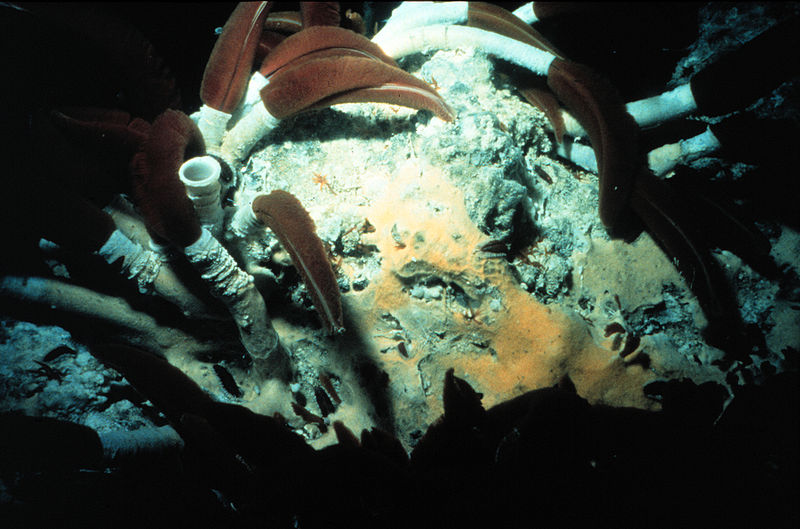
The enormous 2.5 m long tube worms shown above live by a black smoker on the Pacific ocean floor, thriving in a highly pressurized highly acidic boiling hot environment completely devoid of sunlight. They obtain their energy by feeding on huge mats of bacteria, which, in turn, live off the hydrogen sulfide spewed out by the vents. These worms and many of the other organisms that live in these extreme communities do need oxygen for respiration so they are, at least indirectly, dependent on the oxygen supplied by plants here on Earth. However, the bacteria themselves do not need oxygen and these organisms might do just fine in an ocean like that on Europa (and perhaps macrobiotic life that does not respire oxygen could be supported by them). We don't know if Europa has undersea volcanic vents, which could further supply energy and nutrients. There is, as yet, no evidence for life on Europa but the possibility that life could exist deep under its ice surface is definitely intriguing enough to warrant further detailed exploration.

Future Missions to Europa

The Europa Jupiter System Mission will focus on studying Europa and Ganymede for signs of alien life. This mission is slated for launch in 2020 (but, as mentioned, it may have to be altered or postponed).

This video from NASA illustrates this mission's objectives:


This mission will be the first one of its kind to employ two separate spacecraft, each operated independently by its own organization and each gathering its own data, working toward a common set of scientific goals. Many features of the Jovian system will be explored with special focus on Europa and Ganymede. They will be studying not only the habitability of these two moons but also how the gas giant, Jupiter, evolved. This is a conceptual drawing of what the two craft may look like.


NASA announced in April this year that the joint mission might not happen because of budgetary cuts but ESA has recently suggested that it might proceed with a European-led mission. The Russian Federal Space Agency is considering adding an independent segment to the mission, a Europa Lander, which would drill into Europa's surface ice and study its composition (as I understand it, it will not be designed to fully penetrate the ice into the ocean below - this will have to await some unannounced future mission).

 Io

 Last, but certainly not least, Io, named after a mythological priestess of Hera, another of Zeus' many lovers, and the fourth of the Galilean moons of Jupiter, is the single most geologically active object in the solar system. The Galileo spacecraft took this image of the Jovian moon. It passed within 200 km of Io, a hazardous journey even as a flyby because the spacecraft received three times the radiation it was designed to withstand, as Io is within Jupiter's intense plasma torus.


Sulfurous compounds on the surface colour this moon yellow. Sulfur-containing compounds at different temperatures and of different compositions also impart greenish, reddish, brown and black regions to the moon, inspiring some to call it the "pizza moon." All the pockmarks are not impact craters but rather volcanoes. There are over 400 active volcanoes on it right now. Io is the innermost of the four Galilean moons, orbiting a mere 422,000 km from Jupiter, so close that it is continuously and brutally stretched and distorted by Jupiter's intense gravitational pull. This internal frictional force, along with tidal forces from Ganymede and Europa, drives its extreme volcanic activity. If you look at the dark spot just to the right of center you can see a volcano erupting, with its plume of sulfur and sulfur dioxide reaching as high as 500 km into space and a ring of bright yellow newly deposited sulfur surrounding it. Material from the many volcanoes contributes significantly to the large plasma torus around Jupiter, and it produces a thin atmosphere around Io itself. The images below of Io's surface taken by the Galileo spacecraft in November 1999 (left) and again in February 2000 (right), show the progress of an active lava flow, this lava being hotter (1800?C) than lavas produced here on Earth (most are around 800?C). Most of Io's lavas are made of basalt, similar to lavas on Earth, but a few lavas consisting of sulfur and sulfur dioxide (such as the one noted above) have also been observed.


The white sections above on the left represent areas of lava so intensely hot that they overpowered the camera's detector.

A cloud of neutral sulfur, oxygen, sodium and potassium atoms also surround Io at a distance of up to 6 Io radii from the moon surface, a space where Io's gravity is stronger than Jupiter's gravity, although some atoms continuously leak into Jupiter's plasma torus. When Io crosses Jupiter's powerful magnetic field lines, the lines couple Io's atmosphere and neutral cloud to Jupiter's upper polar atmosphere. When this happens an electric current of up to 3 million amps, called a flux tube, produces an aural glow at Jupiter's poles, called the Io footprint, and aurorae in Io's atmosphere (as well as lightning in Jupiter's upper polar atmosphere). Because of where Earth is situated with respect to Jupiter and Io, we receive extra powerful radio transmissions (produced by the flux) from Jupiter when Io is visible to us. As this occurs, Jupiter's powerful magnetic field strips off as much as 1000 kg of material from Io every second, generously seeding Jupiter's plasma torus. This doughnut-shaped cloud of intense radiation inflates Jupiter's magnetosphere to twice the size it would be based on Jupiter's magnetic field alone.
Jupiter's magnetic field lines that get past Io's ionosphere induce an electric current, and resulting induced magnetic field, within Io. It is believed to be generated inside a partly molten silicate magma ocean about 50 km below the moon's surface. The Juno mission headed to Jupiter will explore these interactions between Jupiter and Io in more detail.

Io's orbital resonance with Europa and Ganymede keep it stable in an eccentric orbit that fuels its tidal heating. Without the other moons, Io would eventually have stabilized in a much more circular orbit, and would not be nearly as active.

Io is a bit larger than our moon. Its composition more closely resembles the inner rocky planets than other outer solar system moons. Those moons tend to be a mix of water ice and silicate rocks, whereas Io is unusually dense, even denser than our moon. It is believed to be highly differentiated and made up of a substantial iron-rich core surrounded by a mantle and crust of silicate-rich magma and rock. Io's core does not produce a dynamo, so it is not convective. Whether it is molten or not is unknown, but the tidal forces exerted on Io point to at least partial melting.

Io's atmosphere is very thin and composed mostly of sulfur dioxide, with some sulfur monoxide, sodium chloride, and atomic sulfur and oxygen. Io's volcanoes contribute most of the sulfur dioxide, but its atmospheric concentration is also maintained by sunlight-driven sublimation of frozen sulfur dioxide on the surface. Despite its many volcanoes around which the ground literally sizzles, the surface of Io is very cold, averaging around -150?C. The negligible atmosphere does nothing to trap in heat. The plumes from its many volcanoes probably freeze almost instantly and drift back down as sulfur dioxide snow. It is interesting and unusual for a volatile compound such as sulfur dioxide to pile up and blanket Io's entire surface when it would be expected to be lost in space or perhaps concentrated in Io's cold polar regions. On moons and on rocky planets with exospheres, volatiles such as light gases eventually escape into space. Even though much sulfur dioxide is spewed from Io's volcanoes and lost in space, a significant amount of it also snows back to the surface and accumulates there. In Earth, sulfur is just as abundant as an element as it is in Io, but here on Earth most of it is bound up in sulfide and sulfate minerals. In a way, volcanism has turned Io inside out. Over millennia, the moon has been extracting its sulfur in a process that seems to resemble the ancient Sicilian process, in which sulfur-rich rocks from volcanic regions were piled up and heated in hilltop kilns, allowing sulfur deposits to melt and run down the hills. Io may be maintaining a process similar to what happened on Earth and our Moon billions of years ago, when both likely had similar liquid magma oceans and extremely hot sulfur-spewing volcanoes, but on Earth and the Moon, these processes eventually quieted down while Io, in a tug of war between Europa and Ganymede, has been locked in this hellish state. Considering that Io very likely originated from the same protoplanetary disc as Europa and Ganymede, it is fascinating to see how different it is from these water ice/rock moons.

Thursday, March 3, 2011

Our Solar System Part 9: Uranus

When Voyager 2 approached Uranus  in 1986, it captured a planet that looks more like a cyan blue billiard ball than a celestial body.


This odd planet, 15 times more massive than Earth and orbiting the extreme far reaches of the solar system between Saturn and Neptune, rotates with an axial tilt of 98 degrees, meaning that it is nearly perfectly tilted on its side. Why this planet, and only this planet, is tilted so extremely is one of the great mysteries of our solar system.


Its faint rings, a southern collar of white cloud and a bright cloud (white splotch) in the northern hemisphere can be made out in this  image taken by the Hubble telescope in 2005.


Uranus' Dynamic Atmosphere

In 1986, Voyager 2's rather boring billiard ball image (at the top of this article) gave Uranus a bad rap as a planet where nothing happens. But now, as long-awaited spring comes to its northern hemisphere, bright bands and clumps of convective clouds are bubbling up across the planet. Currently a northern band of clouds seems to be organizing in addition to the earlier southern band of clouds seen in the Hubble image above. You can see the cloud features in excellent detail in the 2004 Keck II Telescope image below, of the two sides of Uranus at near infrared wavelengths. Uranus is oriented about the same, with its north pole at the 4 o'clock position in this image. It is at the 3 o'clock position in the image above.

Photo credit: courtesy Lawrence Sromovsky, UW-Madison Space Science and Engineering Center.

The following time-lapse video made up of Hubble images taken between 1994 and 1998 dramatically shows seasonal changes on the planet, and a fragile wobbling ring system.


Some clouds seem to be as long-lived as 10 years while others pop up and disappear over a matter of days. Scientists are busy observing the planet from the Keck II observatory, which is outfitted with an adaptive optics system  that dynamically changes the shape of the observatory's main mirror in order to reduce the blurring effect from Earth's changeable atmosphere. As of yet, they have no theories to explain these rapid changes in Uranus' atmosphere.

Rings

Studies of Uranus' faint rings suggest that they are relatively young, having formed long after Uranus formed, and are likely the remnants of a moon that broke up from an impact or from gravitational stresses.


This schematic diagram of its rings hints at a close relationship between its rings and its moons.


Our discussion of Uranus' ring system will pick back up when we explore the moons.

Uranus' Name Could Have Been Worse

The discovery and naming of Uranus went through an awkward period. Even though it is visible to the naked eye, it moves so slowly in its orbit, that it was long considered to be a star. Not until Russian astronomer, Johan Lexell calculated the orbit of Uranus in 1781, during the Age of Reason, did it become clear to the scientific community that they were dealing with a planet. After much debate, and going through possible names such as Georgium Sidus, Herschel, and even Neptune Great Britain (which didn't go over well with the scientific community outside Britain) the name Uranus was settled on. It is the Latinized version of the Greek god of the sky, Ouranos.

The Interior of Uranus

Uranus is an ice giant like its sister, Neptune, and like Neptune, it is composed primarily of water, ammonia and methane ices. Unlike Jupiter or Saturn, both of which are gas giants, hydrogen and helium comprise only a small fraction of Uranus' makeup. Uranus is believed to be composed of three basic layers: an insubstantial silicate/iron-nickel core surrounded by an icy mantle that, rather than being ice in the conventional sense, is a hot highly conductive and highly pressurized fluid composed of water, ammonia and other volatiles that is sometimes called a water-ammonia ocean. This fluid layer gradually transitions into a gaseous atmosphere, composed mostly of hydrogen and helium, with decreasing enrichment by volatiles such as water, ammonia and methane as one reaches the outer surface, so that the outermost atmosphere is almost purely hydrogen and helium gas at an extremely cold 49 K, above which a tenuous photochemical haze blankets the planet. This haze, detected around the sunlit pole of Uranus, radiates significant ultraviolet light, a phenomenon called "electroglow." It is difficult to measure wind speeds on Uranus because its clouds are rarely defined, but they have been clocked as high as 860 km/h in the direction of its rotation (as on all the giant planets). Small amounts of methane in the upper atmosphere give Uranus its distinctive blue colour.


Magnetic field

Like Uranus's strange tilt, its magnetic field is peculiar. It doesn't come from the planet's center, but rather its magnetic center is shifted to its south rotational pole and titled 59 degrees from its rotational axis, as illustrated below.

This shift makes its magnetic field highly asymmetrical and about ten times more powerful on its northern hemispheric surface than on its southern surface. Earth's magnetic field is about the same strength at each of its poles, and Earth's magnetic center is about the same as its geographical center. Interestingly, Neptune also has a highly tilted magnetic field, at about 47 degrees, and it is even more severely offset from the planet's center, in this case by at least half a radius. This data points to something these planets share in common that is different from the magnetic fields of either the gas giants or the terrestrial planets. One idea suggests that ice giant magnetic fields are generated by relatively shallow motion within their (electrically convective) water/ammonia oceans, rather than by molten metallic core convection in the case of the rocky planets and liquid metallic hydrogen convection in the case of the gas giants.

Orbit and Discovery of Neptune

Uranus orbits around the Sun once every 84 Earth years, at an average distance from the Sun of 3 billion km. Because it is about twenty times further from the Sun than Earth is, it receives 1/400 of the sunlight Earth does. Once Uranus was discovered, discrepancies in its orbit calculated using Newton's law of gravitation led astronomers to wonder if another unknown body was tugging on the planet. This led astronomers to accurately predict the location of a new planet, Neptune, which orbits much further out at about 4.5 billion km from the Sun, in 1846.

Thanks to Uranus' extreme axial tilt, each pole receives 42 years of continuous sunlight followed by 42 years of complete darkness. Even though the polar regions of Uranus receive more average energy from the Sun over one year, it is hotter at its equator than at its poles. The reason for this is unknown. Uranus total internal heat is significantly lower than that of the other giant planets. Neptune, very close to Uranus both in size and composition (and yet much farther out from the Sun) radiates 2.6 times more heat than it receives from the Sun. Uranus hardly radiates any excess heat at all, making it the coldest planet in the solar system.

Two Unusual Characteristics of Uranus and Two Models Proposed to Explain Them

These two factors, much lower than expected internal heat and a highly tilted axial spin, may point to a massive impact sometime in Uranus' past. One model suggests that an object with a mass of between one and two Earths could have upended the planet and stirred its contents vigorously enough to bring hot material from deep within its interior up to its surface, allowing significantly more heat to dissipate than would have occurred without any such impact. This impact would have occurred fairly early in Uranus' history because its moons, which we will soon explore, orbit around its equator, meaning that they must have formed after the impact.

Another model can accommodate Uranus' unique axial tilt through what is called the Nice model. This widely accepted model of early planetary formation and migration is discussed in detail with regard to Neptune in my Neptune article, in the section "Formation and Early Jostling Around." In this scenario, Uranus was tilted during this early period of planetary migration. For this model to work, Uranus would have needed an additional moon and a temporary large inclination, which itself could have come about from an instability phase acting on all the giant planets at the time, as outlined in the Nice model. That extra moon could have been ejected from its orbit by a close encounter with another body near the end of the planetary migration, during a period called the Late Heavy Bombardment, during which unstable resonances between newly formed giant planets turned a great many asteroids, some of which were enormous (up to several kilometers across) into ultra-fast projectiles. This NASA artist's rendition of our young forming solar system may give you some idea of the chaotic environment in which all the planets formed.


This latter model alone cannot explain Uranus' coldness, but its unusual coldness could be the result of some mechanism through which ordinary convection is inhibited. In this case Uranus does indeed have a hot interior but its heat is somehow prevented from escaping upward and, as a result, the surface is extremely cold and the inner heat eludes our detection. Yet others believe an opposite mechanism explains Uranus' coldness. In this case, something about its interior allows it to release heat more easily than other planets. Why Uranus is so cold remains an open question as no thermodynamic models of these proposed processes have yet been worked out.

Exploration of Uranus

Everything we know about Uranus has come solely through the data from one mission, NASA's Voyager 2 mission in the 1980s. This is what its trajectory looked like:


Voyager 2 is still transmitting data as of August 2, 2011. It is traveling at a mind-boggling 55 thousand km/h and is now about 14.3 billion km away from the Sun. It is now about as far away as the most distant orbiting comets, yet it is still within our theoretical solar system boundary, the heliopause, where solar wind is stopped by the interstellar medium.


Several American NASA-led and European ESA-led missions designed to study the Uranus system have been proposed and have reached the conceptual stage, with launch dates at around 2020, and arrival at Uranus between 12 and 17 years later. Earlier this year a Uranus orbiter and probe mission was recommended by NASA after a mission study was completed but there are currently no plans to carry out any future missions to Uranus. However, as we have seen, new telescope technologies are making it possible to gather a great deal of information about the Uranus system right here from home (or from close Earth orbit).

Uranus' Moons

Unlike the pretty planet itself, Uranus' moons and its rings, are all drab dark grey in colour. Highly energetic ions within Uranus' magnetosphere, probably sloughed off from the planet's upper atmospheric haze, strike the moons as they sweep through them. This bombardment causes relatively rapid darkening of their surfaces, a process called space weathering. This is the same phenomenon that makes ancient impact craters on our moon appear much darker than recent impacts. This NASA image of our moon taken by Apollo 15 shows a young bright crater to at the lower right, in contrast to the darker older craters around it.


The montage image below shows the relative sizes and positions of Uranus' moons (from left to right) Puck, Miranda, Ariel, Umbriel, Titania and Oberon, in comparison to the planet itself.


Uranus has 27 moons in total, all named after characters in the works of William Shakespeare and Alexander Pope.

Its moons are divided into 3 types: 13 inner moons, 5 major moons and 9 irregular moons. The Uranian inner moon system looks like this:


Astronomers, scrutinizing Hubble images of Uranus in 2003, discovered Mab (after Queen Mab, a sprite in Shakespeare's Romeo and Juliet) and Cupid (seemed to the astronomers naming her to be an appropriate name for this tiny body, just 18 km across, orbiting among the great lovers of Shakespeare's literature).

All 13 inner moons orbit within Miranda's orbit (itself a major moon, shown at the left in the diagram above). All of the inner moons are very closely connected to the ring system, which is believed to have come from the fragmentation of one or more inner moons. These moons shepherd, and are a source of, the rings. They constantly perturb one another, creating a chaotic system in which some of these moons will probably eventually collide with each other.

Uranus has 5 major moons, Miranda, Ariel, Umbriel, Titania and Oberon, ranging in diameter from just 472 km (Miranda) to 1578 km (Titania). Titania is about 1/20 of the mass of our moon. These larger moons either arose from the accretion disc that remained just after Uranus' formation or as debris from the impact of a large object with Uranus early in its history. The larger moons may have come from a combination of both processes. Models suggest that past resonances between these moons created significant tidal heating as evidenced by canyons and striations across their surfaces. Most of these features are old, however, meaning that they are not currently undergoing as much flexing. They are also heavily cratered - they have undergone many impacts over the eons that have not been erased by any internally driven resurfacing process, such as volcanism. The largest of these major moons are likely to be internally differentiated into rocky cores surrounded by icy mantles. Titania and Oberon may even have liquid water oceans at their core/mantle boundaries. None of these major moons has any appreciable atmosphere. This image shows their orbits in perspective:


From the center out, they are Miranda, Ariel, Umbriel, Titania and Oberon. The red line indicates Uranus' orbit around the Sun.

Each of Uranus' 9 irregular moons orbits much further out than Oberon. They are probably all objects captured by Uranus' gravity soon after the planet formed. They all have retrograde orbits except for one, and all are very small, no more than 150 km in diameter.

Sunrise on Titania

Because Uranus is tilted on its side, the Sun would follow a small circular orbit around either the north or south pole of the planet, depending on the season. The Sun's trajectory across the sky of one of the major moons would look very similar as well because the moons all have axial tilts very similar to that of Uranus. This artist's conception gives you an idea of what the summer Sun would look on one of the major moons such as Titania.

Wednesday, March 2, 2011

Our Solar System Part 10: More Than Just Planets and a Star

Between 1930 and 1992, our solar system seemed fairly straightforward: a star around which 9 planets and an asteroid belt orbited, and a number of comets with long orbits that periodically travelled close enough to the Sun put on a show for us as they flew past Earth. This beautiful contemporary orrery shows the Sun plated in gold, Earth as a blue glass sphere and our moon as a pearl. These devices, run with a clock-like mechanism, were all the rage in the 1700's and 1800's. This one, a replica, can be purchased new today.


Our universe seemed to fit quite nicely into a planetarium and it was easy to conclude that nothing but a vacuum existed past Pluto, except for populations of impossibly distant stars that seemed of no consequence to us here.

Then a lot of things changed, beginning with our realization that space was not just vast nothingness. Instead, it wielded threats such as extinction-level comets and meteors


The image above is an artist's conception of a large meteor that struck North America approximately 65 million years ago and triggered the Cretaceous-Tertiary extinction.

and gamma ray bursts from supernovae.


Above is an artist's illustration of the gamma ray burst GRB 080319B, detected in 2008. It took place 7.5 billion light years away and even from that incredible distance it was so bright it could be seen by the naked eye.

We learned that our solar system began with chaos and destruction.


This is an artist's conception of the solar nebula, from which the protoplanetary disc would emerge and the planets and other objects would form. The Sun is igniting into a star as the temperature and pressure within its core become sufficient to fuse hydrogen into helium.

Orbiting bodies other than planets and moons were observed - grey areas began to erupt, culminating with the controversial decision to demote Pluto from a planet in 2006. The last century and this one signify a period of rapid evolution of knowledge about our solar system, and we are living right in the fascinating thick of it.

The Search for Planet X

Things began to unravel in the early 1900's when astronomer Percival Lowell found discrepancies in his measurements of the orbits of the outer planets. This led him to believe that an unknown planet must orbit beyond Neptune. and he spent his last years trying to find it. He didn't succeed but after his death his observatory continued his search and eventually found a body orbiting where it was predicted to be, based on the calculated gravitational displacement acting on Uranus and Neptune. In 1930, they named it Pluto, after the Greek god of the underworld. However, astronomers grew increasingly skeptical that this small planet had enough mass to affect the orbits of two giant planets. At the time they thought Pluto was Earth-sized and even that mass would not be enough to have any effect. In 1978, a satellite was discovered orbiting Pluto (its moon, Charon, both of which are visible in the following 1990 photo taken by the Hubble telescope) and this discovery made it possible to accurately measure Pluto's mass.


As suspected, Pluto was found to be inconsequentially small, in fact far smaller than even their predictions. Something else was tugging at the two giant ice worlds. In the meantime, soon after Pluto was discovered, astronomers began to speculate that this planet might not be alone. A search led to the discovery of an entire population of comet-like bodies orbiting between Jupiter and Neptune. However, rather than settling the question about the perturbation of the ice giant's orbits, the discovery of these bodies raised even more questions. These icy bodies, called centaurs, were found to have unstable orbits and they were calculated to have lifetimes of only a few million years.

A New Object: Centaur

Centaurs are unusual objects. They are technically minor planets that share characteristics with both comets and asteroids. A minor planet is an object in direct orbit around the Sun that is neither a classical planet (like Jupiter) nor a comet. Minor planets include dwarf planets, all of which I will define in more detail shortly. Centaurs, named after mythical half horse/half human creatures, are known to cross the orbits of the giant planets, and there are many of them. Our solar system is filled with more than 44,000 of these objects, each of which is larger than 1 km across (the largest being a massive 260 km in diameter). The first centaur was discovered in 1920 and they were first classified as a group in 1977. In this image, centaurs are labeled orange, while all Kuiper Belt objects are bright green (we will be investigating the Kuiper Belt shortly as well).


Perhaps even more strange is that centaurs come in a whole range of colours. This challenges any model of surface composition, but it could be attributed to either composition, origin and/or space weathering. Some of these objects demonstrate comet-like behavior such as a comet-like tail as they near the Sun during their orbit. It should be kept in mind that these are examples of grey-area objects - there is no clear line of distinction between centaurs, comets or asteroids. Much more data on these puzzling objects is needed.

As suggested earlier, the discovery of centaurs raised an obvious question: How could they still exist billions of years after the solar system's (and therefore their) formation? Some outer reservoir of ice must be regularly replenishing them, but what?

In the meantime, in the 1950's, astronomers began to also wonder why comets are still so plentiful in the solar system.  Like centaurs, they were well known to have finite lifespans because their surfaces sublimate* into space every time they draw near the Sun. Comets are small icy bodies, usually less than 50 km across, that display a visible coma (a thin fuzzy temporary atmosphere), the result of sublimation of their icy surfaces into gas when they are struck by sufficient solar radiation. They may also sport a tail visible from Earth as they near the Sun, which is composed of dust that reflects sunlight and gases that glow because they are ionized by solar radiation.

*Comets loose a great deal of mass when they pass near the Sun! For example, Halley's Comet lost 5 x 10¹¹ kg of mass last time it made a close pass.  Extrapolated data, assuming the comet's orbit doesn't change, means that Halley will be gone in 170,000 years. Halley's Comet, its bright tail visible to the naked eye, has streamed past Earth once every 75-76 years ever since it was first recorded in 240 BC. This is what it looked like when we last saw it in 1986.


Comets have been of particular interest to scientists ever since a theory was proposed that Earth's vast reservoir of water might have come from multiple comet impacts during a period early in Earth's history called the Late Heavy Bombardment, and that organic compounds within comets might also have seeded young Earth with the building blocks of life. NASA launched a robotic probe to sample the coma of a comet in 1999. It met up one called Wild 2 in 2004 and collected dust grain samples from the comet's coma. Scientists found a wide range of organic compounds, including two that contain biologically usable forms of nitrogen. In 2005, NASA launched another comet probe, the Deep Impact Spacecraft. This one impacted a comet, creating a large crater in it so that it could remove samples from the comet's interior to send back to Earth to analyze.


The image above is an artist's conception of the Deep Impact Spacecraft landing on the surface of the 370 kg comet called Tempel 1.

They were surprised by the amount of dust inside the comet, which was fine like talcum powder rather than coarse as expected, like sand. They were puzzled to find clays and carbonates, which usually need liquid water to form as well as sodium, which is very rare in space. This dust is debris from the solar system's most distant and coldest regions that formed 4.5 billion years ago. Scientists suspect that Tempel 1 came from a region far past Neptune, based on the amount of low temperature ices, such as ethane, that it contained. This puts it in a group of comets called long-period comets.

There must be a large reservoir of icy bodies very far away from the Sun to explain the origin of these long-period comets, comets that have orbits lasting thousands of years. This suspected reservoir, named the Oort Cloud and first hypothesized by Jan Oort in 1950, is believed to extend into the extreme far reaches of the solar system. This belt is the home of long-period comets but it cannot account for the orbits of short-period comets, of which Halley's Comet is one. In 1988, a Canadian team of astrophysicists ran computer simulations of all observed comets. A group of short-period comets came from an area that was consistently in the same plane as the solar system, whereas Oort Cloud comets came from any point in the sky. This meant that a belt of comets must exist in the same plane as our system, and this has come to be known as the Kuiper Belt. This artist's rendering of the Oort cloud and the Kuiper Belt might help you visualize where these two areas are located in our solar system, and how large they are.


Deciphering the Asteroid Belt, Kuiper Belt and Oort Cloud

All three of these zones contain small bodies, or remnants, from the birth of our solar system.

Asteroid Belt

The Asteroid Belt, by far the innermost belt of objects, orbiting between Mars and Jupiter, is illustrated in the following diagram. 


It contains many asteroids, ranging in size from 950 km in diameter to the size of a dust grain, which are so thinly distributed that several unmanned spacecraft have so far traversed it without incident. Asteroids, also sometimes called planetoids especially the larger ones, are generally what we refer to as the bodies that make up the Asteroid Belt.

This is a composite image of asteroids that have been imaged at high resolution.


Vesta, with a diameter of 530 km, dwarfs the other asteroids and is sometimes called a protoplanet. It may be just massive enough to form a sphere and its interior is thought to be differentiated. Its shape is being investigated and if it is determined that this body maintains hydrostatic equilibrium, it will be reclassified as a dwarf planet. The Dawn Mission sent by NASA, is currently investigating Vesta and afterward it will investigate the dwarf planet, Ceres, shown below with both Vesta (left) and Ceres (right) in this artist's concept).


The asteroids, composed mostly of rock and metal with some sporting an icy mantle, are made up of the same stuff as planets and might have accreted into a planet long ago if they had not been so energized by the gravitational field around Jupiter. Collisions between these asteroids were so violent that they shattered on impact instead of sticking together. They were much more numerous and disordered when the solar system was very young. Many collisions occurred and, over time, most asteroids shot off in different directions, decreasing the mass of the belt to what we see today. Most of these asteroids orbit around 2.7 AU (Earth-Sun distance) from the Sun. This is an interesting distance because it is here where the Sun formed a "snow line" when the belt was forming, the same period during which planets were forming. Chunks of rock that formed beyond this radius were able to accumulate water ice. This belt contains short-period comets within its outer regions. The difference between comets and asteroids is that asteroids come from the warmer inner solar system and are composed mostly of rock and metal. Comets come from the colder outer solar system and are composed of water and other ices, rock and organic compounds. Short-period comets, much more plentiful and volatile in this belt's youth, may have supplied Earth with its water (adding significantly to the outgassing of water vapour from Earth's interior).

Kuiper Belt

The Kuiper Belt is much farther out than the Asteroid Belt, extending from Neptune's orbit (30 AU) to about 55 AU from the Sun. Objects here are similar to those of the Asteroid Belt except that rather than being made up mostly of rock and metal these contain mostly frozen methane, ammonia and water. This belt also contains objects large enough to be classified as dwarf planets. Recall that the Kuiper Belt was first hypothesized as recently as 1988. No one is yet sure how it came to be. Astrophysicists are attempting to answer this question by using new wide-field survey telescopes to find more Kuiper Belt objects (KBO's). So far, they believe that these objects, like those of the Asteroid Belt, are remnants from the original protoplanetary disc around the just-formed Sun and that they failed to coalesce into planets. The largest KBO is less than 3000 km in diameter, too small to meet the requirements of a planet. And, like the Asteroid Belt, gravitation from Jupiter is the most likely culprit. Interestingly, recent computer simulations suggest that neither Neptune nor Uranus formed in situ out here. There wasn't enough raw material even when this belt was young to form them. The Nice Model is the model most often cited to explain the migration of these giant planets from more inner orbits close to Jupiter to their present locations. The repositioning of Neptune and Uranus is thought to have occurred when Jupiter shifted into a powerful 2:1 resonance with Saturn, destabilizing the orbits of the two ice giants. The planetary jostling probably threw many early KBO's into disorder, shooting them off in different directions and depleting the population. Keep in mind that the Nice Model is still a work in progress. It is not without its problems in terms of explaining the location and motion of all the current objects in the solar system – our solar system is an extremely complicated system that challenges even the latest modeling hardware and software.

Oort Cloud

Even though scientists have suspected its existence for over 60 years now, there has yet been no confirmed evidence for the Oort Cloud. One reason for this is that this cloud is very very far away, 50,000 AU. That is about a thousand times further from the Sun than the Kuiper Belt, or almost ¼ of the way to the next nearest star, Proxima Centauri. The Oort cloud defines the limit of our solar system, where the Sun's gravitational force is gradually overcome by the tug of passing stars and the tug of the Milky Way itself, forces at play in local interstellar space. Like the Kuiper Belt, objects that comprise this zone are primarily composed of water, ammonia and methane ices, and they are suspected to have been remnants scattered far out into space by the gravitational forces of the giant planets in the early solar system. This is the hypothetical home of long-period comets, as well as many centaurs. Only four objects, all with highly eccentric orbits have so far been considered as possible members of the Oort group.

If you do some quick internet research you will find other structures of the solar system such as the Scattered Disc and Detached Objects, but the above three main zones of objects hopefully give you a general idea of how the system is set up, keeping in mind that our system did not form itself into discrete objects and zones for our categorical ease. It is our challenge to describe and understand its various indistinct and often puzzling attributes in order to build a picture of how what we see today came to be and what it's future might look like. The following image attempts to put these structures of our solar system into perspective.


Sedna, a dwarf planet past Pluto, is the most distant known object in our solar system, with a highly elliptical orbit ranging between 76 AU and 937 AU, and is used for reference in the above diagram.

Pluto

Pluto is an object of the Kuiper Belt. Lowell's "Planet X," and its four moons, along with many other recently discovered bodies of similar mass as Pluto such as Chiron, Eris, and Ceres, constitute a group of at least 50 and perhaps more than 200 dwarf planets orbiting our solar system within the Kuiper belt. Either all of these would have to be classified as planets or Pluto would have to be reclassified, and so these objects are now known as dwarf planets. The new term, "dwarf planet" refers to any body orbiting the Sun that has enough mass to form a spherical shape under its own gravity (called hydrostatic equilibrium) but not enough gravitational force to clear the neighbourhood around its orbit of debris, and is not a satellite (a satellite is any body that orbits a planet or other body more massive than itself; moons are also called satellites and the distinction between the two terms is often unclear). The second criterion, clearing its orbit, might seem to be a bit subjective and it is. A more massive classical planet has enough mass to gravitationally interact with other bodies within its orbit and eventually cause these smaller bodies to accrete with it, be distributed to another orbit or be captured as a satellite (a moon) or into a resonant orbit (an example of resonant orbit is a special 1:1 orbit. A number of asteroids have the same orbital period as Neptune and follow the same orbital path. This helps define Neptune as a planet - none of the dwarf planets has enough mass to attract any other bodies into resonant orbit).

Pluto is tiny, only about one fifth the mass of our moon, and, along with other dwarf planets, is likely made up of about 60% rock and 40% ice. It may have a differentiated core because it has a large enough portion of rock, and therefore radioactive material, to heat the ice enough to allow the ice and rock to separate from each other. The ice mantle may still be warm enough to allow a subsurface liquid ocean up to 180 km thick to encircle the dwarf planet. It may have a thin exosphere of nitrogen, methane and carbon monoxide. This is an artist's impression of what Pluto's (frozen nitrogen) surface might look like, with the Sun and one of its moons, Charon, in the sky:


Credit: ESO/L. Calçada

Pluto circles the Sun only once every 248 Earth Years, in a highly inclined eccentric orbit that places it between 30 AU, as close as Neptune, and 49 AU.

Past Pluto

If you traveled out into the most distant reaches of our solar system, you would eventually run into the interstellar medium. Notice that I did not say empty space. Our solar wind travels outward from the Sun in all directions at about 400 km/s (that's 1,440,000 km/h!) until it collides with interstellar wind. Interstellar wind is the outward flow of gas, dust and radiation from all the other stars in the Milky Way neighbourhood. The interstellar medium is all that exists in the space in between stars, such as gases in ionic, atomic and molecular forms (99% of matter), as well as dust (1% of matter) and cosmic radiation (it is comprised of both matter and energy). Interstellar space is not a perfect vacuum, but it is extremely dilute, making it a much better vacuum in any practical sense than we can make in a laboratory. Within the densest regions of interstellar medium, inside molecular gas clouds, stars form. Where it is most dilute, few or no stars exist. The collision between solar wind and the interstellar wind is called termination shock, about 90 AU from the Sun upwind and 200 AU from the Sun downwind. The solar wind at this juncture slows, condenses and grows turbulent. Particles become highly energetic in this region. Both Voyager 1 and 2 have just recently passed termination shock. Past termination shock, the pressures of the solar wind and opposing interstellar wind are in balance and this marks the heliopause and the beginning of interstellar space. You can think of the heliosphere as a gigantic bubble surrounding all the planets inflated by solar wind (which itself is powered by the Sun's vast and powerful magnetic field that protects us from deadly galactic radiation). As the heliosphere with the solar system encapsulated inside it plows through space, a bow shock forms in front of it, just like water bunching up in front of a big rock in a stream. This artist's view depicts several structures associated with our heliosphere.


In the center you can see the Sun and the planetary orbits. The edge of the bubble encasing them is termination shock. Voyagers 1 and 2 have just crossed this boundary. The region outside it is called the heliosheath and it is bound by the heliopause. Beyond this region to the left are orange bunched up molecular gas clouds. This marks the bow shock, where galactic radiation collides with our Sun's heliosphere. Right now our Sun is travelling through the Local Interstellar Cloud, a gas/dust cloud about 30 light years across that flows outward from a star-forming region called the Scorpius-Centaurus Association within the Milky Way.

Voyager 1, launched in 1977, is now about 94 AU from the Sun. Having successfully traversed the Asteroid Belt and flown past Jupiter and Saturn, it took the first ever "family portrait" of our solar system as seen from outside (at about 40 AU from Earth) before it embarked on its current Interstellar Mission. The solar system's family portrait is shown below.


This picture is a mosaic of 60 frames. Six planets are visible in the mosaic and labeled. An image of Earth in this mosaic, famously called "The Pale Blue Dot" by Carl Sagan, was captured from about 6 billion km away. It is the very tiny speck just visible halfway down the brown band to the right within the darkness of space in the image below.


Observing our planet, I leave it to you to feel either uncomfortably inconsequential or, borrowing from the movie, "Contact," rare and precious.

Voyager 1 is now the most distant man-made object in the universe. It is now within the heliosheath and sending back data daily thanks to its long–lived nuclear batteries, which are expected to last until around 2020, at which point it should have entered interstellar space.

The Interstellar Boundary Explorer, A NASA satellite, was launched in 2008 to explore the boundary between the solar system and interstellar space. So far, data has revealed a completely unexpected result: a very narrow very bright ribbon of energetic neutral atoms created by interactions between the solar wind and the galactic wind, which seems to be in continuous flux. These findings will certainly help us refine our concepts about the outer solar system boundary.

A Link Between the Oort Cloud and Extinction Events

The Oort cloud is thought to extend far beyond the heliosphere, from about 5000 AU to about 50,000 AU from the Sun. The generally slowly moving objects that make up this cloud are still weakly bound by the Sun's gravity. However, comets in the outer regions of the Oort cloud are also influenced by galactic tidal forces, and these often complex forces may have a significant effect on comet activity. As many as 90% of all comets originating from the Oort cloud may be the result of perturbations caused by the galactic tide. The galactic tide is a tidal force acting on all objects within the gravitational field of the Milky Way. Passing stars and molecular clouds are also sources of comet perturbations. There may be a link between high comet activity and the location of the Sun within the Milky Way. The Sun orbits the galaxy center, revolving on the outskirts within the Orion spiral arm as shown below.


Computer models show that the Sun bobs up and down through the plane of the Milky Way as it revolves around the galaxy. As we pass through the densest part of the plane, once every 35 to 45 million years, increased gravitational forces from surrounding giant gas and dust clouds tend to dislodge more comets from their paths, increasing the probability that one or more will be sent hurtling toward Earth. Evidence from craters on Earth and the record of past extinction events, the latest of which was the Cretaceous-Tertiary Event 65.5 million years ago, wiping out the dinosaurs, lends support to this theory. Our present position in the galaxy suggests that we are due for another "active" period. Another related but opposing theory suggests that the solar system is barraged by as much as 24 times more interstellar radiation every 60 million years or so, when it bobs up out of the plane of the Milky Way and exposes its "head," putting greater stress on the biosphere and possibly leading to mass extinctions. In this case, while we are on the upswing now, we are about 10 million years off of any significant increase in cosmic ray exposure. It's entirely possible that both of these long-term variations in the solar system environment have and will continue to contribute to our environment on Earth.

A Brief Look Into the Future

I think the traditional view of the solar system is that it is steadfast and ever unchanging and in an effort to challenge this view I may have left you with the impression that it is dangerously unstable and chaotic. Despite its early chaos it is in fact a very stable system. The positions of the planets have settled into resonant orbits that keep them in place quite nicely and are expected to continue to do so for a very long time, until our Sun begins to expand into a Red Giant. The Sun is growing brighter as it evolves, at a rate of increase of 10% every billion years. One billion years from now, Earth will be too hot as a result of this process to sustain liquid water on its surface and it will no longer be considered habitable. By that time, numerous comet and asteroid impacts will have left heir marks on various planets and Earth will have evolved through several long-term and dramatic changes in climate and habitability much as it has undergone in the past. The orbits of the major bodies will have shifted as well. In fact, our extremely precise long-term computer models of orbital rotation in the solar system will be valid for only about 10 million years before small but consistent chaotic changes will be sufficient to throw them off. Any immediate threats to human life from within and from outside our solar system are very remote. I urge you to relax and enjoy our lovely backyard and explore the neighbourhood.